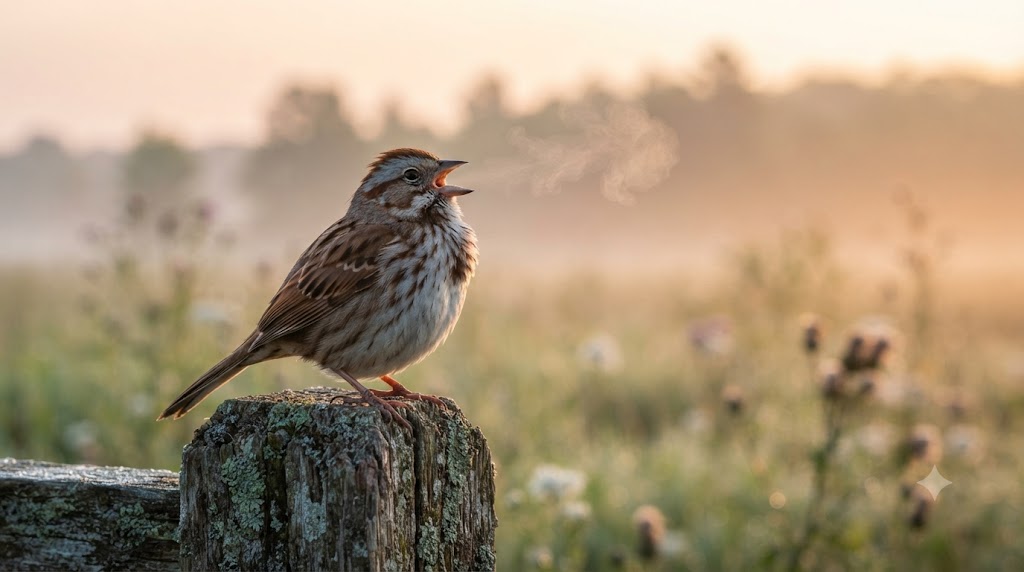
🗣️ Avian Linguistics and Acoustic Ethology
To the untrained ear, all sounds emanating from the forest are simply “bird songs.” To an ornithologist, however, avian acoustic repertoires are structured languages comprising distinct functional categories. Discover the critical behavioral and neurobiological distinctions separating true territorial songs, flight calls, begging whines, contact notes, and nuanced multi-tier predator alarm systems.
- Functional taxonomy: Primary Song vs. Calls, Chips, and Chits
- The seet alarm vs. mobbing scold: acoustic physics of predator defense
- Nocturnal flight calls (NFCs): acoustic monitoring of nighttime flyways
- Innate acoustic structures vs. culturally learned vocal dialects
Table of Contents
- The Spectrum of Avian Acoustic Communication
- Defining Primary Song: Territorial Defense and Sexual Advertisement
- Subsong and Plastic Song: The Ontogeny of Vocal Learning
- Call Notes: The Everyday Lexicon of Cohesion and Navigation
- The Acoustic Physics of Alarm Calls: The Aerial ‘Seet’ vs. The Ground Scold
- Contact Notes and Pair Cohesion in Flocking Species
- Nocturnal Flight Calls (NFCs): Deciphering the Night Sky
- Functional Acoustic Classification Matrix
- How to Conduct Acoustic Mobbing and Alarm Surveys in the Field
- Frequently Asked Questions (FAQ)
- Conclusion: Listening to the Forest’s Hidden Dialogue
1. The Spectrum of Avian Acoustic Communication
Avian communication is one of the most sophisticated signaling systems on our planet. Far from producing random or ornamental sound, birds utilize an extensive acoustic vocabulary tailored to specific social, environmental, and survival contexts. A single backyard Song Sparrow or Black-capped Chickadee possesses a repertoire of dozens of distinct vocalizations, each conveying precise biological information about identity, food availability, spatial location, and imminent mortal danger.
In scientific bioacoustics, vocalizations are categorized based on two fundamental criteria: their neurological origin (innate versus culturally learned) and their primary behavioral function. Understanding the dividing line between formal songs, functional call notes, and emergency alarm signals is the foundation of advanced field ornithology.
💡 The Fundamental Rule
Song is for romance and real estate (courtship and territory); calls are for everyday business (staying in touch, finding food, and sounding alarms). Songs are typically long, complex, and learned; calls are short, simple, and genetically hardwired.
2. Defining Primary Song: Territorial Defense and Sexual Advertisement
In the strict ornithological sense, **song** refers to complex, rhythmic, often musical vocalizations produced primarily by males during the breeding season. Primary song serves two monumental evolutionary purposes:
1. Territorial Real Estate Defense: Broadcasting ownership over a specific parcel of nesting habitat. When an established male sings from a high, exposed perimeter perch, his song warns rival males that the territory is defended, preventing costly, dangerous physical battles.
2. Mate Attraction and Female Stimulation: Advertising genetic fitness, physical stamina, and nutritional condition to prospective females. The complexity, volume, and consistency of song provide female listeners with reliable diagnostic data regarding male health and age.
In songbirds (Oscines), primary song is not hardwired at birth; it requires an intricate process of sensory motor learning. Young nestlings must hear adult tutors during a critical “sensitive window,” store an auditory memory template in their brain, and spend months practicing their vocal output to match the tutor’s template.
3. Subsong and Plastic Song: The Ontogeny of Vocal Learning
The development of song in a young bird mirrors human speech acquisition with uncanny precision:
- Subsong (The Avian Babbling Phase): In late summer and autumn, juvenile birds produce quiet, rambling, disorganized vocalizations known as subsong. Subsong is the avian equivalent of infant babbling: young birds flex their syringeal muscles and experiment with sound production without territorial intent.
- Plastic Song: During their first winter and early spring, young birds refine their phrases, gradually eliminating aberrant notes and matching their vocalizations to adult territorial standards.
- Crystallized Song: By their first breeding season, high testosterone levels trigger “crystallization.” The neural pathways in the brain’s High Vocal Center (HVC) solidify, locking the song into a stable, stereotyped adult performance.
4. Call Notes: The Everyday Lexicon of Cohesion and Navigation
Unlike seasonal breeding songs, **call notes** are short, simple, unmusical vocalizations produced year-round by both males and females. Calls are largely genetically innate—a young sparrow raised in total isolation will produce normal contact and alarm calls without ever hearing an adult bird.
The everyday vocabulary of birds encompasses dozens of functional call types:
- Location / Contact Calls: Soft chirps, chips, and clicks emitted continuously while foraging in dense brush to maintain spatial awareness with flock members.
- Flight Calls: Distinctive notes sounded upon takeoff and in mid-flight to synchronize flock movements and coordinate aerial banking.
- Food and Begging Calls: Frantic, wheezing, high-pitched vocalizations produced by nestlings and fledglings to stimulate parental feeding flights.
- Aggression and Scolding Calls: Harsh, rasping snarls emitted during boundary disputes over feeder perches or roosting branches.
5. The Acoustic Physics of Alarm Calls: The Aerial ‘Seet’ vs. The Ground Scold
Perhaps no aspect of avian bioacoustics is more fascinating than predator alarm signaling. Birds do not possess a single generic “danger!” call; they deploy fundamentally different acoustic weapons depending on whether a predator is hunting from the sky or stalking on the ground.
A. The Aerial ‘Seet’ Call: Physics of Acoustic Concealment
When a flying Cooper’s Hawk or Peregrine Falcon sweeps across the canopy, passerines emit a thin, high-pitched, whispery whistle known as the **seet call** (typically between 7 and 9 kHz). The acoustic structure of the seet call is an evolutionary masterpiece of anti-predator engineering:
Because the call begins and ends with gradual volume fades (soft onset and decay) and lacks sharp abrupt consonants, it gives the hunting hawk’s ears zero binaural time-difference cues. The hawk hears the warning and knows prey is alert, but cannot triangulate the exact location of the caller! The moment the seet sounds, all birds in the woodlot freeze instantly, dropping into dense cover.
B. The Mobbing Scold: Physics of Directional Recruitment
Conversely, when a perched predator—such as a roosting Eastern Screech-Owl or a resting cat—is discovered, birds execute the exact opposite acoustic strategy. They produce loud, harsh, explosive, wide-bandwidth scolding calls (like the raucous “chick-a-dee-dee-dee” of chickadees or the screaming rattles of Blue Jays).
These calls are packed with abrupt, staccato clicks and wide frequency spans, making them exceptionally easy to locate. The goal here is active recruitment: broadcasting precise coordinates to summon dozens of neighboring birds to form an aggressive mob, darting around the owl and harassing it until it is forced to abandon the area.
6. Contact Notes and Pair Cohesion in Flocking Species
In dense winter feeding flocks or migrating groups, birds utilize soft, continuous “contact notes” to maintain flock cohesion without alerting predators.
In American Goldfinches, individuals maintain unique vocal “names”—acoustic flight notes that identify the specific individual. Mated pairs of cardinals and chickadees continuously exchange quiet ‘tsip’ notes while foraging on opposite sides of a thick briar patch, allowing them to track each other’s movements through dense brush without breaking visual foraging focus.
7. Nocturnal Flight Calls (NFCs): Deciphering the Night Sky
One of the most exciting frontiers in modern field ornithology is the acoustic monitoring of **Nocturnal Flight Calls (NFCs)**. As millions of songbirds, thrushes, and shorebirds fly through dark night skies during spring and autumn migration, they emit short, high-frequency chips, peeps, and buzzes lasting just 50 to 200 milliseconds.
These flight calls prevent mid-air collisions in dense nocturnal migratory streams, maintain flock orientation through low clouds, and stimulate weary birds to keep flying. By setting up a sensitive pressure-zone microphone pointed at the night sky connected to automated spectrogram software (such as Vesper or Raven), birders can record and identify thousands of migrating thrushes, cuckoos, and warblers passing silently overhead in the dark!
8. Functional Acoustic Classification Matrix
| Vocal Category | Typical Acoustic Duration | Learned vs. Innate | Primary Behavioral Objective | Key Field Example |
|---|---|---|---|---|
| Primary Song | 2 to 8+ seconds | Learned (in songbirds) | Territory defense; female mate attraction | Wood Thrush liquid flute song; Robin carols |
| Aerial ‘Seet’ Alarm | 0.5 to 1.5 seconds | Innate genetic reflex | Warning of flying raptors without giving away caller’s location | High 8 kHz thin whistle of titmice & sparrows |
| Mobbing Scold Call | Rapid staccato bursts | Innate genetic reflex | Broadcasting location to summon flock to harass perched predator | Harsh chickadee ‘dee-dee-dee’ mobbing calls |
| Contact / Cohesion Note | 10 to 50 milliseconds | Innate / learned variations | Maintaining flock spacing while foraging in dense brush | Soft ‘tsip’ of warblers; ‘pip’ of cedar waxwings |
| Nocturnal Flight Call | 50 to 200 milliseconds | Innate species-specific | Airspace collision avoidance during night migration | Swainson’s Thrush ‘spring peeper’ nocturnal calls |
| Begging / Food Whine | Continuous wheeze | Innate juvenile reflex | Stimulating adult parents to feed young fledglings | Wheezing, fluttering whines of juvenile robins |
9. How to Conduct Acoustic Mobbing and Alarm Surveys in the Field
Field naturalists can decode local woodland dynamics by actively listening for mobbing and alarm vocalizations:
- Stop When the Forest Goes Quiet: A sudden, eerie silence across a woodland usually means an aerial predator (hawk or falcon) has been spotted and an aerial seet call was sounded. Look up into the sky or scan high snag perches immediately.
- Follow Raucous Commotions: If you hear an explosive chorus of screaming Blue Jays, scolding chickadees, and chattering wrens gathered in a single dense conifer, follow the sound quietly. Ninety percent of the time, the mob will lead you directly to a camouflaged roosting owl or a climbing rat snake.
- Learn to Separate Call Types: Challenge yourself to distinguish between the territorial song of a cardinal and its sharp, metallic ‘chip’ alarm note. Separating songs from calls is the true hallmark of field literacy.
10. Frequently Asked Questions (FAQ)
Q1: Can birds understand the alarm calls of other species?
Yes! Avian alarm calls represent an open-source, interspecific communication network. When a Tufted Titmouse or Black-capped Chickadee gives an aerial seet or mobbing call, nuthatches, woodpeckers, sparrows, and even mammals like chipmunks and squirrels decode the signal instantly and take appropriate defensive action.
Q2: Why do some birds make non-vocal mechanical sounds?
Mechanical sounds (“sonations”) evolved in species where visual or vocal displays are constrained. Woodpeckers drum on resonant hollow snags to broadcast territory because drumming carries significantly further through dense hardwood trunks than vocal calls.
Q3: Do birds have specific distress calls when captured by predators?
Yes. When seized by a hawk or predator, birds produce loud, piercing, wide-frequency distress screams. Biologists hypothesize these screams serve to startle the predator into loosening its grip or attract secondary apex predators that may attack the captor, providing a slim window for escape.
Q4: Can birders use night flight calls to identify migrants?
Yes. Each species of warbler, thrush, and sparrow possesses a distinct nocturnal flight call with a unique duration, frequency sweep, and harmonic structure. Software like Raven can analyze spectrograms to verify species crossing overhead in complete darkness.
Q5: What is ‘whisper song’ in birds?
Whisper song (or quiet song) is an extraordinarily soft, muted rendition of primary song sung at near-inaudible volumes. Birds use whisper song when communicating intimately with a mate on a nest or when practicing song near a dominant rival’s boundary to avoid provoking an attack.
11. Conclusion: Listening to the Forest’s Hidden Dialogue
When we recognize that bird sounds are not merely pleasing aesthetic background music, but an intricate, highly structured ecological language, our relationship with nature deepens immeasurably. Every chip, trill, whistle, and alarm note is a pulse of real-time intelligence reflecting the timeless struggle for life, love, and territory. By tuning our ears to this rich acoustic dialogue, we become true participants in the living symphony of the wild.
The Neurobiology of Song Learning: FoxP2 and Neural Auditory Feedback
The capacity for vocal learning—learning to produce complex sounds through acoustic imitation—is extraordinarily rare in the animal kingdom, shared only by humans, cetaceans, elephants, bats, and three distinct avian orders: songbirds (Passeriformes), parrots (Psittaciformes), and hummingbirds (Trochilidae).
At the molecular genetic level, vocal learning in birds is governed by the FoxP2 gene—the exact same speech gene implicated in human language development and verbal dyspraxia. During periods of active song learning, FoxP2 expression surges in the avian striatum (specifically Area X). Young birds listen to their own vocal output, comparing it against the auditory memory template stored in their brain. If a note deviates from the template, neural auditory feedback loops fire error signals, prompting the motor syrinx to adjust air pressure and muscle tension until the note matches the tutor with micro-pitch precision.
Cultural Dialects and Geographic Acoustic Drift
Because songs are learned culturally from local adult tutors rather than inherited through rigid genetics, songbird populations develop regional dialects. In White-crowned Sparrows (Zonotrichia leucophrys) along the California coastline, researchers have documented distinct vocal dialects separated by mere miles of open pasture.
A female White-crowned Sparrow exhibits strong behavioral preference for males singing her natal home dialect, as a local song confirms that the male possesses genetic adaptations suited to the micro-climate and native parasites of that specific county. When human urban development fragments habitats, acoustic isolation accelerates, causing dialects to diverge into completely separate sub-languages within decades.