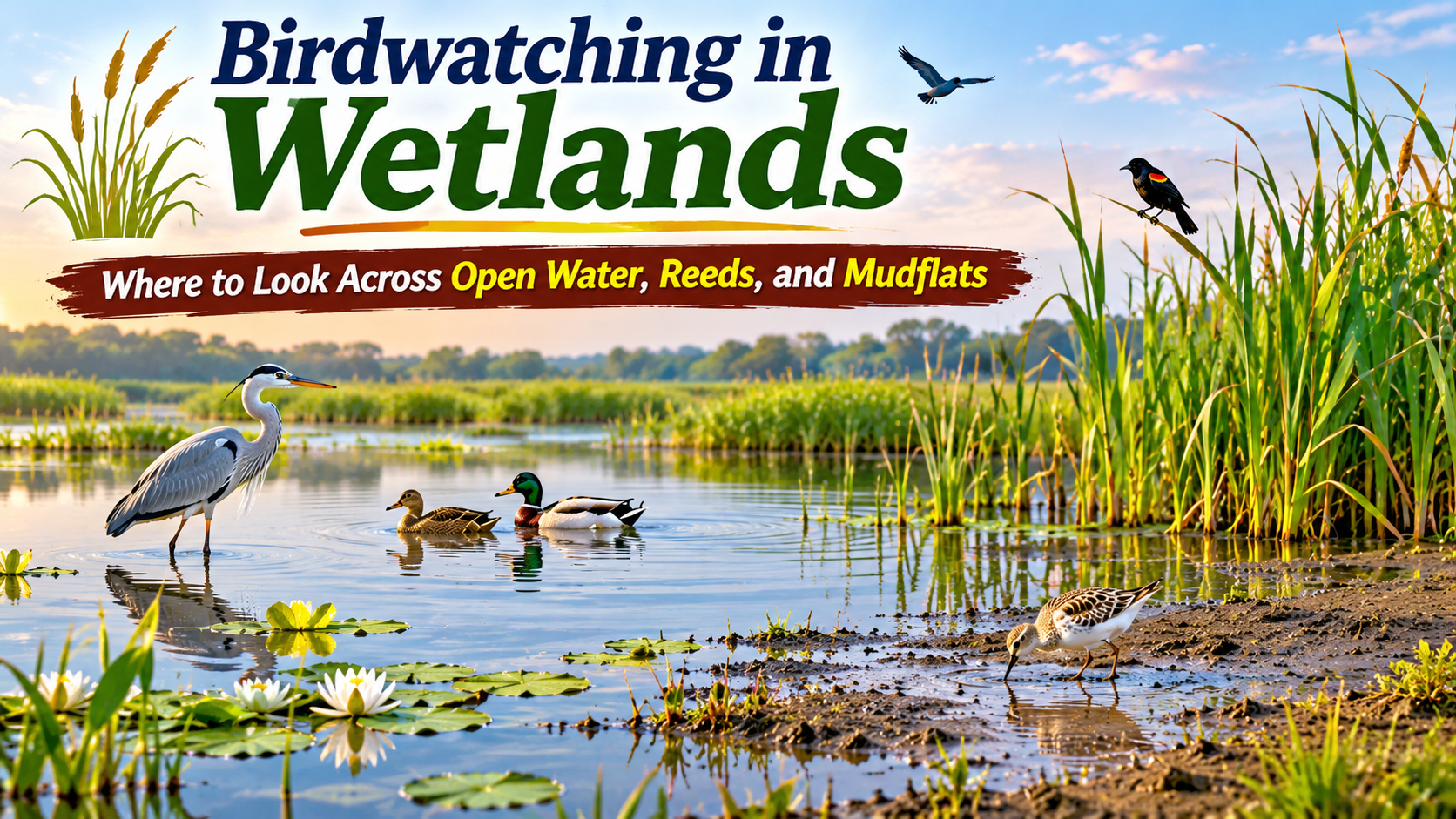
WETLAND EXPLORER / FIELD GUIDE 03
Every Corner of a Wetland Has a Story.
Discover where birds gather, feed, hide, and rest across open water, reedbeds, muddy shorelines, and shallow wetland habitats.
🌊
OPEN WATER
🌾
REEDBEDS
🐦
MUDFLATS
Wetlands are among the most interesting environments for birdwatching.
A single wetland may contain open lakes, shallow pools, dense reedbeds, muddy shorelines, grassy banks, and small islands.
Each habitat provides different opportunities for birds to feed, rest, breed, or find shelter.
For beginners, however, a large wetland can feel overwhelming.
Where should you look first?
Should you scan the open water, watch the reeds, or search the muddy edges?
The answer depends on the birds you hope to observe and the conditions at the site.
Some species spend much of their time swimming or diving in open water. Others remain concealed in vegetation, while shorebirds search exposed mud for small animals.
Learning to recognize these habitat differences can make wetland birdwatching more organized and rewarding.
This guide explains where to look across different wetland environments, how water levels and tides affect bird activity, and how to observe wildlife responsibly.
Why Wetlands Attract So Many Birds
Wetlands provide several important resources for birds.
Water, aquatic plants, fish, insects, mollusks, and other small animals create feeding opportunities for many species.
Vegetation offers shelter and potential nesting habitat.
Open water and isolated islands may provide resting areas away from some land-based disturbances.
Wetlands are also important during migration.
Many migratory birds use suitable wetlands to rest and replenish energy before continuing their journeys.
Different birds use different parts of the same wetland.
For example, diving birds may search for food underwater, while long-legged waders feed in shallow water.
Small birds may move through reeds, and shorebirds may concentrate on exposed mud.
Understanding these patterns helps you predict where birds are most likely to appear.
WETLAND OBSERVATION PRINCIPLE
Different habitats attract different birds.
Instead of searching the entire wetland randomly, divide the landscape into smaller observation zones and examine each one carefully.
1. Birdwatching Across Open Water
Open water is often the most visible part of a wetland.
It may include lakes, reservoirs, lagoons, large ponds, or broad areas of flooded habitat.
Depending on the location and season, these areas can attract ducks, geese, swans, grebes, coots, cormorants, pelicans, and other waterbirds.
Some birds remain on the surface while feeding.
Others dive underwater and may disappear for several seconds before resurfacing.
Where to Look on Open Water
Begin by scanning the nearest visible water.
Look for individual birds, small groups, and larger flocks.
Next, scan toward the center of the wetland.
Pay attention to areas where birds gather near floating vegetation or changes in water depth.
Finally, examine the far shoreline.
Birds may be resting on exposed banks, islands, logs, or other structures.
Watch for Diving Behavior
Birds that repeatedly disappear underwater may be searching for aquatic plants, fish, or invertebrates.
Observe how long they remain submerged and how they move before diving.
These behaviors can provide useful identification clues.
Observe Groups Carefully
Large flocks may contain more than one species.
Rather than assuming every bird in a group is identical, compare body size, bill shape, head markings, and posture.
Take your time when scanning distant groups.
Binoculars are useful, while a spotting scope can provide additional detail at large wetlands.
2. Searching Reedbeds and Dense Wetland Vegetation
Reedbeds can be among the most challenging wetland habitats for birdwatchers.
Tall reeds, rushes, sedges, and other vegetation provide cover for birds that may rarely appear in the open.
Some species move quietly through the stems.
Others briefly emerge along vegetation edges before disappearing again.
Depending on the region, reedbeds may support rails, crakes, bitterns, reed warblers, marsh-dwelling songbirds, and other wetland species.
Listen Before Looking
Birds hidden in reeds are often detected by sound before they are seen.
Pause near a permitted viewing area and listen carefully.
Try to identify the direction of calls or movement.
Do not enter dense vegetation to investigate.
Remaining on established paths protects sensitive habitat and reduces disturbance.
Watch the Reed Edges
The boundary between reeds and open water can be productive.
Birds may emerge briefly to feed, cross small gaps, or move between vegetation patches.
Focus on natural openings rather than attempting to look through every stem.
Notice Subtle Movement
A moving reed stem may indicate an animal passing through vegetation.
However, wind and other wildlife can create similar movement.
Wait quietly and look for additional evidence before assuming a bird is present.
Patience is particularly valuable in dense wetland habitats.
3. Birdwatching Along Mudflats
Mudflats are exposed areas of soft sediment found along lakes, estuaries, tidal shorelines, and other wetlands.
They may appear empty from a distance, but they can support abundant small animals beneath the surface.
Worms, mollusks, crustaceans, and other invertebrates provide food for many shorebirds.
Sandpipers, plovers, godwits, curlews, stilts, and other waders may use suitable mudflat habitats.
The exact species depend on the region, season, water conditions, and available food.
Start at the Waterline
Birds often feed where shallow water meets exposed sediment.
Scan slowly along this boundary.
Small shorebirds may blend into the mud, making movement easier to detect than color.
Look for Feeding Patterns
Different birds use different feeding techniques.
Some probe their bills into the sediment.
Others pick visible food from the surface or move rapidly through shallow water.
Observe bill length, leg length, feeding posture, and movement.
These details can help distinguish similar-looking shorebirds.
Check Exposed Banks and Small Islands
Not every bird on a mudflat is actively feeding.
Some may be resting, preening, or gathering in groups.
Raised areas and islands can provide important resting locations.
Use binoculars or a spotting scope rather than approaching these areas.
IMPORTANT MUDFLAT SAFETY NOTE
Never walk onto unfamiliar mudflats to get closer to birds.
Soft sediment, hidden channels, changing tides, and unstable ground can create serious hazards. Use established paths, observation hides, and designated viewpoints.
4. Explore Shallow Water and Wetland Margins
The shallow edges of wetlands often provide excellent opportunities for observing birds.
These transitional areas connect open water with vegetation, mud, and surrounding land.
Herons, egrets, ibises, spoonbills, and other wading birds may search for food in suitable shallow habitats.
Some stand almost motionless while watching for prey.
Others walk slowly through the water or sweep their bills while feeding.
Look for birds standing near vegetation, small pools, and gently sloping banks.
Observe the depth of the water relative to the bird’s legs.
Different feeding methods and body proportions may help narrow identification possibilities.
Shallow margins can also attract smaller birds that feed near the water’s edge.
5. Do Not Ignore Islands, Banks, and Overhead Airspace
Wetland birdwatching involves more than looking directly into the water.
Small islands may support resting or nesting birds.
Exposed banks can attract waterfowl and shorebirds.
Nearby trees may provide perches for cormorants, herons, and other species.
The air above wetlands is also worth checking.
Depending on the region, swallows, terns, gulls, raptors, and migrating birds may fly over open water.
Watch for birds circling, hovering, gliding, or repeatedly diving toward the surface.
Remember to keep a respectful distance from nesting colonies and resting flocks.
Wetland Birdwatching: Where to Look by Habitat
| Habitat | Bird Groups to Look For | Useful Observation Clues |
|---|---|---|
| Open water | Ducks, grebes, coots, cormorants | Swimming, diving, flock patterns |
| Reedbeds | Rails, bitterns, reed-associated songbirds | Calls, subtle movement, brief appearances |
| Mudflats | Sandpipers, plovers, godwits, stilts | Bill shape, probing, walking patterns |
| Shallow margins | Herons, egrets, ibises, spoonbills | Wading depth, posture, feeding behavior |
| Islands and banks | Gulls, terns, waterfowl, other resting birds | Roosting groups, preening, resting |
| Air above wetlands | Terns, swallows, gulls, raptors | Flight style, wing shape, hunting behavior |
These are general habitat associations rather than guaranteed sightings. Bird communities vary considerably between wetlands and geographic regions.
How Tides Affect Wetland Birdwatching
At coastal wetlands and estuaries, tides can strongly influence where birds feed and rest.
As the tide falls, additional mudflat habitat may become exposed.
Shorebirds can spread across these areas to search for food.
As the tide rises, exposed feeding areas become smaller.
Birds may move toward higher ground or established roosting locations.
High tide can make some groups easier to count when they gather together, while lower tides may provide better opportunities to observe feeding behavior.
However, viewing conditions vary between sites.
At very low tide, birds may be too distant for comfortable observation.
Before visiting a tidal wetland, check a reliable local tide table and follow the reserve’s guidance.
Never cross mudflats or tidal channels to follow birds.
Best Time of Day for Wetland Birdwatching
Early morning is often a useful time to visit wetlands.
Some birds may be actively feeding, moving between habitats, or vocalizing.
Calm conditions can also make distant sounds easier to detect.
Late afternoon may provide another productive observation period.
However, the best timing depends on the species, weather, season, and water conditions.
At tidal wetlands, the tide may be more important than the exact hour.
For non-tidal lakes and marshes, water levels and seasonal bird activity may have a greater influence.
Check reserve opening hours and allow sufficient daylight for a safe return.
A Simple Wetland Scanning Technique
Large wetlands are easier to observe when you follow a consistent scanning pattern.
Instead of moving your binoculars randomly, divide the landscape into smaller sections.
The Five-Zone Wetland Scan
Zone 1 — Near shoreline: Check the closest mud, rocks, shallow water, and vegetation before moving forward.
Zone 2 — Reed edges: Look for movement and listen for calls around natural openings.
Zone 3 — Open water: Scan swimming birds, floating groups, and diving activity.
Zone 4 — Far shoreline: Examine distant banks, exposed sediment, islands, and resting flocks.
Zone 5 — Airspace: Look above the wetland for flying, soaring, and hunting birds.
Move slowly between zones.
When you notice something interesting, stop and observe before continuing.
This method can help reduce missed sightings while keeping your attention organized.
Essential Equipment for Wetland Birdwatching
Wetland environments often involve long viewing distances, exposed conditions, and muddy paths.
A small amount of preparation can improve comfort and observation.
- Binoculars: Useful for observing birds without approaching them.
- Spotting scope: Optional equipment for viewing distant waterbirds and shorebirds.
- Field guide: Helps compare local species and identification features.
- Notebook: Useful for recording sightings, behavior, and habitat conditions.
- Weather-appropriate clothing: Important in windy, cold, or sunny conditions.
- Suitable footwear: Helps with established paths that may be wet or uneven.
- Water and sun protection: Support comfort during longer visits.
A spotting scope can be valuable at large wetlands, but beginners can start with binoculars or simply observe nearby birds.
Equipment should help you maintain a respectful distance rather than encourage closer approaches.
How to Identify Wetland Birds More Confidently
Wetland birds may appear similar when viewed from a distance.
Many ducks share related body shapes, while shorebirds can have subtle differences in plumage.
Begin with the bird’s overall size and silhouette.
Then observe the shape of its bill, legs, wings, and tail.
Watch how it moves and feeds.
For shorebirds, feeding behavior and bill proportions may provide important clues.
For ducks, head shape, body proportions, and plumage patterns can be useful.
For herons and egrets, consider size, neck posture, bill shape, and leg appearance.
Use a regional field guide to compare likely species.
When the evidence is insufficient, record the bird at a broader group level rather than forcing an identification.
Keeping Field Notes During a Wetland Visit
Field notes can help you understand how birds use different parts of a wetland.
Record the date, time, weather, location, and habitat type.
For tidal sites, note the approximate tide state.
For inland wetlands, note visible water conditions where relevant.
Describe what the birds were doing rather than recording only their names.
Wetland Field Journal — Example
Date: October 18
Time: 8:15 AM
Location: Public wetland viewing platform
Weather: Mild, partly cloudy, light breeze
Open water: Several ducks swimming and occasionally diving
Reed edge: Small bird heard calling but not clearly seen
Mudflat: Small shorebirds walking and probing the sediment
Notes: Species identification to be reviewed later
This fictional entry demonstrates how observations can be organized by habitat.
Responsible Birdwatching in Sensitive Wetland Habitats
Wetlands are important feeding, resting, and breeding environments.
Disturbance can interrupt these activities.
Shorebirds may need to feed for extended periods to maintain energy reserves, especially during migration.
Repeatedly forcing birds to fly can waste energy and reduce feeding opportunities.
Follow these responsible observation practices:
- Remain on designated trails, boardwalks, and viewing platforms.
- Keep a respectful distance from feeding and resting birds.
- Never approach nests or breeding colonies.
- Avoid entering reedbeds and sensitive shoreline vegetation.
- Do not chase birds for photographs.
- Keep dogs under control and follow local restrictions.
- Avoid disturbing high-tide shorebird roosts.
- Follow all reserve access rules and seasonal closures.
If birds repeatedly move away or stop feeding because of your presence, increase your distance.
Responsible observation protects wildlife and often produces better opportunities to watch natural behavior.
Common Wetland Birdwatching Mistakes
Beginners sometimes overlook productive habitats because they focus only on obvious birds in open water.
Other common mistakes include:
- Ignoring the nearest shoreline before scanning distant water.
- Walking too quickly past reedbeds.
- Overlooking small shorebirds that blend into mud.
- Failing to check local tide conditions.
- Approaching resting flocks too closely.
- Assuming every bird in a flock belongs to the same species.
- Forgetting to observe the air above the wetland.
- Attempting to identify distant birds without enough evidence.
Slowing down and following a consistent scanning method can improve your observations.
Frequently Asked Questions About Wetland Birdwatching
Where should beginners look for birds in wetlands?
Start with the nearest shoreline, then examine reed edges, open water, distant banks, exposed mud, and the air above the wetland.
What birds are commonly found in open water?
Depending on the region, open water may support ducks, grebes, coots, cormorants, geese, swans, and other waterbirds.
Why are mudflats important for shorebirds?
Mudflats contain small animals such as worms, mollusks, and crustaceans that provide food for many shorebird species.
What birds live in reedbeds?
Reedbeds can provide habitat for rails, crakes, bitterns, reed-associated songbirds, and other species adapted to dense wetland vegetation.
Is high tide or low tide better for birdwatching?
Both can be useful. Lower tides expose feeding areas, while higher tides may concentrate shorebirds at resting sites. The best viewing conditions depend on the location.
Do I need a spotting scope?
No. A spotting scope is helpful for distant birds, but binoculars are sufficient for many beginner wetland observations.
How can I watch wetland birds without disturbing them?
Use designated viewpoints, maintain a respectful distance, avoid sensitive nesting and feeding areas, and allow birds to continue their natural behavior.
Final Thoughts
Wetland birdwatching becomes more rewarding when you learn how different birds use different habitats.
Open water may reveal swimming and diving birds.
Reedbeds can conceal secretive species that are easier to hear than see.
Mudflats provide feeding opportunities for shorebirds, while shallow margins attract many wading species.
Islands, banks, and overhead airspace add further opportunities for observation.
Rather than searching the entire landscape randomly, divide the wetland into smaller zones and examine each carefully.
Consider water levels, tides, season, weather, and habitat conditions when planning your visit.
Most importantly, observe from a respectful distance and protect the natural behavior of the birds you encounter.
With patience and a little practice, even a familiar wetland can reveal new details during every visit.
THE WETLAND EXPLORER METHOD
Scan the Water. Listen to the Reeds. Watch the Mudflats. Respect the Wildlife.
Every wetland habitat offers a different window into the lives of birds. Careful observation helps you discover them without disturbing their world.