🧭 Seasonal Exploration Guide
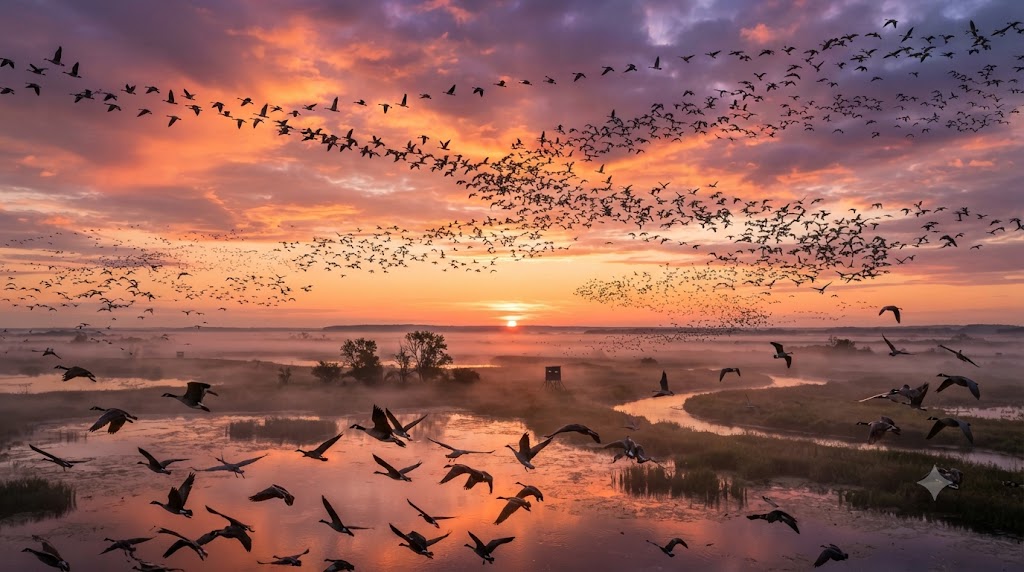
Avian migration is one of the most magnificent phenomena on Earth. Billions of birds traverse thousands of miles along continental flyways, timing their journeys to seasonal pulses of insect blooms, seeds, and weather fronts. By understanding seasonal ecology, weather patterns, and stopover ecology, birders can experience spectacular migratory spectacles throughout all four quarters of the year.
- Deciphering radar ornithology and nocturnal fallout conditions
- Spring migration mechanics: high-speed transit and breeding plumage
- Summer territorial dynamics, breeding biology, and post-fledging dispersal
- Autumn migration dynamics: leisurely feeding, juvenile influxes, and coastal concentration
- Winter survival adaptations, northern irruptive species, and thermal roosting
Table of Contents
- The Continental Flyway System and Atmospheric Dynamics
- Spring Migration: The High-Stakes Race Northward
- Stopover Ecology: How Fuel Depots Dictate Migration Success
- Summer Birding: Breeding Territories, Nesting, and Juvenile Fledglings
- The Late-Summer Molt Lull: Understanding Cryptic Avian Behavior
- Autumn Migration: Protracted Journeys, Molts, and Pelagic Riches
- Raptor Migration Dynamics: The Science of Ridgeline Hawkwatches
- Winter Birding: Arctic Irruptions, Waterfowl Flocks, and Feeder Ecology
- Seasonal Target Matrix for North American & European Ecosystems
- How to Use Weather Radar (NEXRAD) to Predict Migrant Fallouts
- Step-by-Step Field Exercise: Building a 12-Month Phenology Journal
- Frequently Asked Questions (FAQ)
- Summary: Cultivating a Four-Season Field Mindset
1. The Continental Flyway System and Atmospheric Dynamics
Across the globe, avian migration funnels along primary geographic corridors known as flyways. In the Americas, four monumental flyways dominate: the Atlantic, Mississippi, Central, and Pacific Flyways. In Europe, Africa, and Asia, major conduits include the East Atlantic Flyway, the Black Sea/Mediterranean Flyway, the Central Asian Flyway, and the East Asia–Australasia Flyway. These global highways follow fundamental geological topographies—continuous coastlines, river valleys, mountain chains, and narrow oceanic isthmuses—that provide thermal lift for heavy soaring birds and abundant stopover feeding resources for weary songbirds.
Migration is fundamentally an atmospheric undertaking. Small passerines weighing less than a third of an ounce often travel at altitudes between 2,000 and 7,000 feet, taking advantage of supportive tailwinds behind shifting synoptic pressure systems. In the Northern Hemisphere, south winds accompanying clockwise-circulating high-pressure systems facilitate spring northward flights, while crisp northerly winds trailing cold fronts trigger mass southward departures during the autumn months. When these flying masses encounter opposing headwinds, heavy precipitation, or dense fog, they are forced down to ground level in breathtaking events known as “fallouts.”
Understanding the relationship between atmospheric physics and flight mechanics allows the modern birder to forecast migratory movements with astonishing accuracy. Migrating birds do not fly blindly into oncoming storm systems; they delay departure until barometric pressure stabilizes and prevailing wind vectors blow in their target direction. By learning to read surface weather analysis charts, birders can predict exactly which mornings will yield dozens of new species in local woodlots.
💡 Meteorological Key
Always monitor weather fronts in spring and autumn. The morning immediately following a rainy cold front that collides with an active nocturnal flight is when city parks, coastal woodlots, and peninsular tips become densely packed with exhausted, colorful migrants.
2. Spring Migration: The High-Stakes Race Northward
Spring migration is characterized by intense evolutionary urgency. Male songbirds race northward from Neotropical wintering grounds across Central and South America to reach temperate boreal forests, northern hardwoods, and Arctic tundra breeding territories. Arriving early allows superior males to claim prime nesting territories featuring optimal food supplies, secure nest cavities, and low predator densities. Consequently, spring transit occurs at remarkable velocity, often spanning only four to six weeks from late March through late May.
For birdwatchers, spring is universally celebrated as the most visually captivating season. Songbirds arrive adorned in fresh, vibrant alternate (breeding) plumage. Warblers, tanagers, orioles, grosbeaks, and thrushes sing with full acoustic vigor throughout morning hours, broadcasting territorial ownership and advertising fitness to arriving females. Leaves on deciduous trees are just beginning to emerge, creating a narrow, magical window where visibility into high forest canopies is vastly superior to the dense greenery of midsummer.
Key Spring Field Strategies
- Focus on Flowering Canopy Trees: Migrating insectivores concentrate heavily on flowering oaks, willows, and maples where emerging catkins attract massive swarms of tiny caterpillars and midges. A single mature white oak in full bloom can host dozens of warbler species simultaneously.
- Visit Ecological Traps and Migrant Traps: Isolated green patches along coastal barrier islands or urban centers (e.g., Central Park in New York, High Park in Toronto, Point Pelee in Ontario) serve as lifesavers for migrating birds, concentrating thousands of individuals into compact viewing zones.
- Track Emergence of Aquatic Midges: Riparian corridors and lakeshores provide steady insect fuel even on chilly mornings when terrestrial forest canopies remain quiet due to low morning temperatures.
- Follow the ‘Green Wave’ of Leaf-out: As spring advances northward at approximately 15 to 20 miles per day, track the timing of bud break in your local flora to time your field outings with peak caterpillar abundance.
3. Stopover Ecology: How Fuel Depots Dictate Migration Success
While the spectacular flight of birds captures the human imagination, the true bottleneck of migration occurs on the ground at stopover sites. Birds spend roughly 90% of their total migration time and energy resting and refueling at stopover habitats, and only 10% in active powered flight. A songbird crossing the Gulf of Mexico consumes almost half of its total body mass in lipids during an uninterrupted 20-hour flight. Upon landfall, its internal organs—including digestive stomach muscles—have shrunk to conserve weight, and it must immediately seek lipid-dense food to restore organ mass and rebuild fat reserves.
Stopover habitats fall into three distinct functional categories: “Fire escapes” (small, resource-poor emergency refuges where birds rest briefly during storms), “Convenience stores” (moderate habitats where birds feed for a day or two), and “Full-service resorts” (vast, food-rich ecosystems like Delaware Bay or coastal cypress swamps where birds linger for one to two weeks, doubling their body weight before the next major flight). Protecting these critical refueling hubs is the cornerstone of international migratory bird conservation.
4. Summer Birding: Breeding Territories, Nesting, and Juvenile Fledglings
As the frantic pace of spring transit winds down in early June, the landscape transitions into the breeding and nesting season. While overall species counts per outing may decline as transient passage migrants disperse across vast northern latitudes, summer provides unmatched opportunities to observe intimate behavioral ecology, pair bonding, parental provisioning, and juvenile dispersal.
During June and July, adult birds are tethered to specific nesting territories. Singing becomes more localized and persistent around nest perimeters. Patient observers can witness complex behavioral sequences: courtship feeding, gathering of spider silk and moss for nest construction, distraction displays (such as the broken-wing act executed by Killdeer to lead predators away from ground scrapes), and the relentless foraging runs of parent birds ferrying grubs and insects to insatiable nestlings. By late summer, clumsy juvenile birds with streaked underparts and buffy feather edgings begin exploring habitats alongside their parents.
5. The Late-Summer Molt Lull: Understanding Cryptic Avian Behavior
Between late July and late August, many birders experience what feels like a total disappearance of birds from their local woods. Feeder traffic drops off sharply, forests fall quiet, and bird activity seems non-existent. This phenomenon is known as the “late-summer molt lull.”
After the grueling physical demands of rearing one or two broods of chicks, adult birds must completely replace their frayed, damaged flight feathers before undertaking their long southward journey. Because shedding primary wing feathers severely impairs flight agility and speed, birds become extraordinarily secretive. They cease singing, retreat deep into dense briar thickets, blackberry patches, and tangled river bottoms, and spend their days quietly feeding and preening. Recognizing that the birds have not vanished—they have merely shifted to cryptic survival mode—allows patient naturalists to discover hidden juvenile flocks and molting adults by quietly watching dense brush piles and water features.
6. Autumn Migration: Protracted Journeys, Molts, and Pelagic Riches
Unlike the hurried sprint of spring, autumn migration is a leisurely, protracted marathon spanning five months from July through November. Shorebirds—including sandpipers, plovers, and godwits—initiate southward departures as early as late June once their rapid Arctic nesting duties conclude. Neotropical songbirds follow throughout August and September, while waterfowl, sparrows, and raptors move in peak numbers during October and November.
Autumn birding poses unique identification challenges that sharpen observational prowess. Many species undergo a post-breeding molt into subtle basic (non-breeding) plumage. Furthermore, the overall bird population is swollen with naive hatch-year juveniles exhibiting intermediate feather patterns. Immature “confusing fall warblers,” drab flycatchers, and subtle sparrows require birders to look beyond flash colors and rely on structural morphology, primary feather extensions, bill proportions, and subtle vocal call notes.
💡 Autumn Hawkwatch Season
From September to November, elevated ridgetops and coastal peninsulas host spectacular raptor concentrations. As northerly winds deflect off mountain ridges, creating upward deflection currents, thousands of Broad-winged Hawks, Sharp-shinned Hawks, Harriers, and Peregrine Falcons glide south with minimal wing expenditure.
7. Raptor Migration Dynamics: The Science of Ridgeline Hawkwatches
While songbirds migrate primarily under the cover of night, raptors are diurnal migrants that harness solar energy to travel. Birds of prey have heavy bodies and large wing surfaces. Flapping continuously for hundreds of miles would exhaust their metabolic reserves within hours. Instead, they rely on two aerodynamic phenomena: thermals and ridge lift.
Thermals are rising columns of warm air generated when sunlight heats bare fields, dark rock faces, and urban parking lots. Hawks enter these columns, circling upward without a single wingbeat until they reach cloud base, then glide effortlessly downward on a gradual trajectory toward the next thermal. Ridge lift occurs when prevailing perpendicular winds strike mountain ridges (such as the Appalachian or Rocky Mountain chains) and are deflected vertically upward. Raptors surf these invisible air waves for hundreds of linear miles like aquatic surfers. Hawk watch stations situated on strategic ridgetops, such as Hawk Mountain in Pennsylvania or Cape May in New Jersey, routinely tally tens of thousands of raptors during autumn cold front passages.
8. Winter Birding: Arctic Irruptions, Waterfowl Flocks, and Feeder Ecology
While winter may appear quiet and stark at first glance, it holds profound rewards for dedicated naturalists. Foliage is completely absent from deciduous trees, granting unobstructed views of trunk-foraging nuthatches, creepers, woodpeckers, and mixed winter feeding flocks. Dense flocks of wintering waterfowl—including mergansers, goldeneyes, canvasbacks, scaup, and swans—gather on ice-free bays, reservoirs, and coastal estuaries in spectacular congregations.
Winter is also the season of “irruptions”—dramatic southward movements of boreal and Arctic species triggered by cyclic failures of northern seed crops or lemming populations. Depending on northern mast conditions, birders in temperate latitudes may experience unforgettable influxes of Snowy Owls, Bohemian Waxwings, Pine Grosbeaks, Evening Grosbeaks, Red Crossbills, and Common Redpolls. Concurrently, backyard feeding stations become vital biological lifelines where birders can observe social hierarchies among juncos, chickadees, cardinals, and American Tree Sparrows at intimate close range.
9. Seasonal Target Matrix for Birders
Plan your annual birding calendar using the strategic seasonal framework detailed in the matrix below:
| Season | Target Avian Groups | Focal Ecosystems | Prime Observation Strategy |
|---|---|---|---|
| Spring (March–May) | Wood-Warblers, Tanagers, Thrushes, Flycatchers | Urban parks, coastal woodlots, river corridors | Early morning song identification; scanning flowering oak and willow canopies |
| Summer (June–July) | Breeding songbirds, nesting raptors, marsh birds | Boreal forests, high-elevation ridges, protected wetlands | Observing breeding behavior, territorial displays, parental feeding flights |
| Autumn (Aug–Nov) | Shorebirds, migrating raptors, sparrows, pelagics | Mudflats, mountain ridgeline hawkwatches, open fields | Focusing on structural field marks, flight silhouettes, call notes, and coastal drift |
| Winter (Dec–Feb) | Waterfowl, gulls, sea ducks, owls, winter finches | Open water reservoirs, coastal harbors, agricultural fields, feeders | Midday scanning of open water with spotting scope; monitoring feeder stations during snowstorms |
10. How to Use Weather Radar (NEXRAD) to Predict Migrant Fallouts
One of the most revolutionary advances in modern field birding is the application of weather surveillance radar to monitor avian migration in real time. Modern Doppler weather radar stations detect biological targets—specifically millions of birds and bats ascending into nocturnal flight after sunset.
To read nocturnal migration on radar platforms (such as BirdCast or raw base reflectivity maps):
- Check Radar 45 Minutes Post-Sunset: Watch for concentric blooms of low-reflectivity blue and green signals radiating outward from radar towers. Unlike weather rain clouds that move uniformly in linear fronts, bird blooms expand radially as songbirds take off from localized woodlots into the night sky.
- Analyze Base Velocity: Examine velocity products to determine flight speed and direction. If nocturnal migrants are traveling at 25–40 knots northward in May, millions of birds are actively passing overhead.
- Cross-Reference with Advancing Cold Fronts: If you observe intense nocturnal migration heading north that intersects a line of thunderstorms or rain cells between 2:00 AM and 5:00 AM, the birds are forced to ground immediately. Head to the nearest green patch at dawn for a legendary fallout experience.
11. Step-by-Step Field Exercise: Building a 12-Month Phenology Journal
Phenology is the study of periodic plant and animal lifecycle events and how they are influenced by seasonal variations in climate. To become a master of seasonal birding, establish a 12-month phenology journal for your home patch:
- Record First-of-Season (FOS) Dates: Log the exact date you hear your first singing Song Sparrow, see your first chimney swift, or detect your first arriving Ruby-throated Hummingbird.
- Correlate with Botanical Events: Note what trees or wildflowers are blooming simultaneously. You will quickly discover reliable ecological linkages: for example, Yellow Warblers often arrive when lilacs bloom, while thrushes peak during dogwood flowering.
- Track Last-of-Season (LOS) Departures: In the autumn, record the final departure dates of common summer residents as they head toward the tropics.
- Review Year-Over-Year Trends: After two or three seasons, your personal phenology data will allow you to anticipate arrival dates down to a 48-hour window, elevating your birding precision to professional levels.
12. Frequently Asked Questions (FAQ)
Q1: Why do most small songbirds migrate exclusively at night?
Nocturnal migration offers three profound survival advantages: the nighttime atmosphere is cooler and significantly less turbulent, minimizing metabolic overheating and dehydration; predatory hawks and falcons are diurnal and cannot hunt effectively in darkness; and birds can utilize celestial navigation cues (such as stars and constellations) alongside Earth’s magnetic field.
Q2: How far can a small songbird travel in a single night of migration?
Under favorable tailwind conditions, small passerines like the Blackpoll Warbler or Red-eyed Vireo routinely cover 200 to 400 miles (320 to 640 km) in an uninterrupted 8-to-10 hour nocturnal flight. Some species, including the Blackpoll Warbler during transoceanic flights from New England to South America, fly non-stop over open Atlantic waters for 60 to 80 continuous hours.
Q3: What should I plant in my garden to assist migrating birds?
Plant native keystone trees and berry shrubs. Native oaks, birches, and cherries support hundreds of native caterpillar species—the primary superfood that insectivores require to rebuild depleted fat stores. Supplement these with high-lipid autumn berry producers like dogwoods, viburnums, serviceberries, and elderberries.
Q4: Is it normal to see fewer birds in August and early September?
Yes. This period is known as the late-summer molt lull. Adult birds shed and replace flight feathers worn down during nesting. Because missing flight feathers compromises their agility and leaves them vulnerable to predators, birds become quiet, secretive, and stay concealed within dense thickets until plumage renewal is complete.
Q5: What are winter finch irruptions and why do they happen?
Winter finch irruptions are large-scale southward movements of boreal birds like redpolls, crossbills, siskins, and grosbeaks. They are driven by cyclical boom-and-bust seed production cycles (mast crops) of boreal trees such as spruce, fir, birch, and mountain ash. When northern seed crops fail in winter, finches migrate south in search of food.
13. Summary: Cultivating a Four-Season Field Mindset
To observe birds through the changing calendar is to synchronize one’s consciousness with the rhythmic heartbeat of the biosphere. Rather than packing binoculars away when spring concludes, embrace the distinctive challenges and ecological treasures of each season. By pairing meteorological awareness with habitat patience, your field journal will chronicle an unbroken, awe-inspiring pageant of planetary life across all twelve months of the year.