🌿 Parulidae Identification Masterclass
New World wood-warblers (family Parulidae) are universally adored by birdwatchers for their jewel-like colors, hyperactive foraging, and intricate melodies. Yet their sheer diversity—over 50 distinct species migrating across North America—combined with seasonal molts, juvenile variations, and high canopy feeding habits makes warbler identification both the most exhilarating and confounding pursuit in spring and autumn birding.
- Mastering the ‘Warbler Neck’ challenge: scanning canopy micro-strata
- The Primary Dichotomy: Wing bars vs. unbarred wings
- Deconstructing ‘Confusing Fall Warblers’: structural clues and undertail coverts
- Vocal identification: separating buzzy trills from musical cadences
- Robert MacArthur’s micro-niche foraging zones in coniferous and hardwood forests
Table of Contents
- The Allure and Mystery of the Wood-Warbler Family
- Anatomical Topography: The Essential Warbler Diagnostic Map
- The First Major Sorting Fork: Wing Bars vs. Plain Wings
- Underbody Coloration and Flank Patterning
- Facial Patterns: Eyebrows, Eye Rings, and Cheek Patches
- Cracking the ‘Confusing Fall Warbler’ Code
- The Leg and Foot Color Matrix in Drab Autumn Warblers
- Foraging Niches: Vertical Stratification in the Forest
- Acoustic Sorting: Buzzy Trills, Slurred Whistles, and Chipping Notes
- Comprehensive Warbler Identification Matrix
- Step-by-Step Diagnostic Protocol for High-Canopy Warblers
- Frequently Asked Questions (FAQ)
- Conclusion: Embracing the Warbler Migration Spectacle
1. The Allure and Mystery of the Wood-Warbler Family
Known affectionately to naturalists as the “butterflies of the avian world,” New World wood-warblers (family Parulidae) represent a spectacular radiation of small, insectivorous songbirds. Measuring four to six inches in length and weighing barely a third of an ounce, these avian gems undertake monumental twice-yearly journeys spanning from the cloud forests of the Andes to the sprawling boreal spruce forests of Canada and Alaska.
For field birders, warbler watching is an intoxicating mixture of delight and frustration. Warblers rarely remain stationary; they hop frantically along trembling twigs, glean microscopic leafhoppers from beneath oak foliage, flutter at branch tips, and vanish into the canopy in fractions of a second. Confronted with fleeting glimpses, the observer must possess an organized mental sorting system that filters fifty potential species down to a single definitive answer in seconds.
Furthermore, because warblers feed on ephemeral insect hatches, they synchronize their migratory stops with botanical bud breaks across thousands of miles. Arriving in a forest at the precise moment oak catkins unfold yields dozens of species actively feeding within a few dozen square yards. Understanding their plumage anatomy and behavioral signatures transforms high canopy glimpses into immediate identifications.
💡 The Golden Rule of Warblers
Never look at the entire bird all at once. Direct your gaze immediately to two diagnostic zones: the wings (presence or absence of wing bars) and the face (presence or absence of an eye ring or eyebrow stripe). This binary split eliminates 70% of candidate species instantly.
2. Anatomical Topography: The Essential Warbler Diagnostic Map
To articulate and identify warbler features accurately, one must master specific topographical terms:
- Undertail Coverts (Crissum): The small feathers shielding the base of the tail on the underside. Whether these feathers are bright yellow, pure white, or buff is one of the most reliable, constant field marks, remaining unchanged even in drab autumn plumages.
- Rump (Uropygium): The patch of feathers immediately above the base of the upper tail. A bright yellow rump is the signature field mark of Yellow-rumped, Cape May, and Magnolia Warblers.
- Wing Bars: Contrasting pale tips on the greater and median wing coverts. Wing bars are either prominent (two distinct white bars), faint, or completely absent.
- Auriculars (Cheek Patches): The area of feathers covering the bird’s ear opening behind the eye. Contrasting cheek patches (e.g., the chestnut cheeks of the Cape May Warbler or the black mask of the Common Yellowthroat) provide immediate diagnostic confirmation.
- Loral Region (Lores): The small feathered space between the eye and the base of the upper mandible. Whether the lores are dark, pale, or bordered by a line is critical in separating vireos from warblers.
3. The First Major Sorting Fork: Wing Bars vs. Plain Wings
The most effective way to organize the 50+ species of North American warblers is to divide them immediately into two structural categories based on wing pattern:
Group A: Warblers with Bold Wing Bars
This group encompasses the diverse genus Setophaga. If you see two distinct white or yellowish wing bars, your candidates include:
- Black-throated Green Warbler: Vibrant yellow face, dark olive crown, black throat, white belly with dark flank streaks.
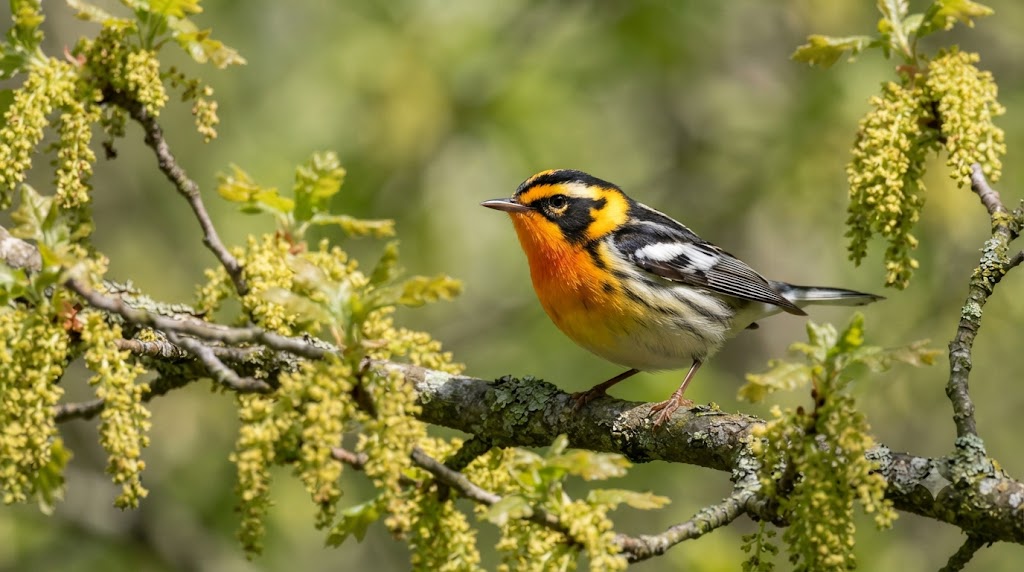
- Blackburnian Warbler: Flame-orange throat and face, triangular black cheek patch, bold white wing patch.
- Chestnut-sided Warbler: Golden-yellow crown, white face with black mustache, rich chestnut flank stripes.
- Pine Warbler: Unstreaked olive-green back, yellow throat and breast with diffuse blurry streaks, sturdy bill, and two crisp white wing bars.
- Black-and-white Warbler: Striking zebra-striped body, black-and-white striped crown, creeping nuthatch-like bark behavior.
- Cerulean Warbler: Sky-blue upperparts, pure white throat and belly, narrow blue breast band in males, and two bold white wing bars.
Group B: Warblers with Plain, Unbarred Wings
If the wings are completely solid olive, gray, or brown with zero wing bars, candidate species narrow dramatically:
- Yellow Warbler: Entirely golden-yellow plumage, plain yellow-green wings, reddish-chestnut breast streaks in males.
- Common Yellowthroat: Olive back, blazing yellow throat and breast, jet-black bandit mask in males, plain wings.
- Prothonotary Warbler: Glowing golden-orange head and breast, blue-gray unbarred wings, pure white undertail coverts.
- Tennessee Warbler: Olive-green back, white or pale yellow underparts, crisp white supercilium (eyebrow), and completely plain wings.
- Orange-crowned Warbler: Overall drab olive-yellow, faint blurry breast streaks, split eye ring, completely plain wings.
- Mourning Warbler: Olive-green back, yellow belly, solid gray hood extending down the chest to a dark bib in adult males.
4. Underbody Coloration and Flank Patterning
Because warblers spend much of their time foraging high in mature hardwood canopies, birders frequently view them from directly underneath—a perspective known colloquially as “warbler neck.” In this angle, the underparts become your primary identification canvas.
Observe whether the underparts are clean white (Black-throated Blue Warbler male, Cerulean Warbler), solid yellow (Yellow Warbler, Blue-winged Warbler), or two-toned (yellow throat transitioning abruptly to a white belly, as in the Northern Parula or Magnolia Warbler). Pay close attention to flank streaking: are the streaks crisp black pencil lines (Black-throated Green), blurry olive smudges (Pine Warbler), or rich reddish-chestnut stripes (Chestnut-sided, Bay-breasted)?
5. Facial Patterns: Eyebrows, Eye Rings, and Cheek Patches
The facial design of a warbler serves as its definitive visual signature. Always look for these specific facial architectures:
- Complete Eye Rings: A bold, unbroken white ring around the eye indicates a Connecticut Warbler, Nashville Warbler, or Canada Warbler.
- Broken Eye Rings (Split Arcs): Two distinct white arcs above and below the eye indicate a Northern Parula or Orange-crowned Warbler.
- Prominent Supercilium (Eyebrow): A sharp pale line above the eye indicates a Worm-eating Warbler, Louisiana Waterthrush, or Tennessee Warbler.
- Spectacles: An eyering joined to a pale line across the lores to the bill, seen in Yellow-breasted Chats.
- Necklace of Streaks: A delicate necklace of jet-black spots across a bright yellow breast confirms a Canada Warbler.
6. Cracking the ‘Confusing Fall Warbler’ Code
In late August and September, millions of warblers head south. The brilliant, high-contrast breeding colors of spring are replaced by muted, olive-drab basic plumages, accompanied by millions of immature hatch-year birds. Roger Tory Peterson famously coined the term “confusing fall warblers” to describe this notorious challenge.
💡 The Fall Triumvirate: Blackpoll vs. Bay-breasted vs. Pine
In autumn, Blackpoll Warblers, Bay-breasted Warblers, and Pine Warblers all exhibit greenish-yellow plumage with two white wing bars. Separate them by undertail coverts and feet: Blackpolls have white undertail coverts and pale yellowish-orange feet; Bay-breasteds have buffy undertail coverts, traces of rufous on flanks, and dark feet; Pine Warblers have unstreaked backs, stout bills, and yellow throats.
7. The Leg and Foot Color Matrix in Drab Autumn Warblers
When plumage is drab, washed out, and ambiguous, foot and leg colors provide definitive diagnostic answers that never fade or molt. In autumn:
- Blackpoll Warbler: Pale yellowish-pink or flesh-colored feet contrasting with dark gray legs.
- Bay-breasted Warbler: Solid dark blackish-brown legs and feet.
- Pine Warbler: Uniform gray-brown legs with a significantly stouter, thicker bill.
- Black-and-white Warbler: Yellowish pads on the soles of the feet that provide friction for vertical bark climbing.
8. Foraging Niches: Vertical Stratification in the Forest
In 1958, legendary ecologist Robert MacArthur published a landmark ecological study demonstrating that five species of warblers coexisting in the same spruce trees occupied distinct vertical feeding zones, preventing competition. Birders can utilize MacArthur’s vertical stratification to aid identification:
- Forest Floor and Leaf Litter: Ovenbirds, Louisiana Waterthrushes, Northern Waterthrushes, and Mourning Warblers forage almost exclusively on the ground, walking along logs and tossing dead leaves.
- Understory Shrubbery (0 to 10 feet): Hooded Warblers, Canada Warblers, Kentucky Warblers, and Common Yellowthroats stay low in dense briars and ferns.
- Trunk and Bark Layer: Black-and-white Warblers hitch up and down tree trunks and large limbs like nuthatches.
- Middle Canopy: Chestnut-sided Warblers, Magnolia Warblers, and American Redstarts forage actively in middle-layer foliage, flashing tails and wings to flush insects.
- High Canopy Treetops: Blackburnian Warblers, Cerulean Warblers, and Northern Parulas spend their lives 60 feet up in the uppermost sunlit leaves.
9. Acoustic Sorting: Buzzy Trills, Slurred Whistles, and Chipping Notes
Because warblers are frequently obscured by dense leaf cover, learning their vocal signatures accelerates field identification by 300%. Warbler vocalizations divide into distinct acoustic categories:
- Buzzy Trills: Rapid insect-like trills. Northern Parula gives an ascending buzzy trill ending in an abrupt downward note (“zeeeee-up!”). Black-throated Green sings a lazy, lisping buzz mnemonic (“trees, trees, murmuring trees”).
- Musical Whistles: Sweet, clear whistling cadences. Yellow Warbler belts out a cheerful, energetic phrase translated as “sweet, sweet, sweet, I’m so sweet!” Chestnut-sided Warbler gives an upbeat greeting: “pleased, pleased, pleased to meet’cha!”
- Loud Ground Melodies: The Ovenbird emits an explosive, ringing chant that echoes through hardwood forests, accelerating in volume: “teacher, TEACHER, TEACHER!”
10. Comprehensive Warbler Identification Matrix
| Warbler Species | Wing Bar Status | Key Facial Field Mark | Underpart Color & Pattern | Foraging Stratum |
|---|---|---|---|---|
| Blackburnian Warbler | Bold Double White Bars | Intense flame-orange throat & face mask | White belly, heavy black flank streaks | Uppermost high deciduous canopy |
| Black-throated Green | Bold Double White Bars | Bright yellow cheeks, olive crown | White belly, jet-black throat & bib | Middle-to-upper evergreen and oak canopy |
| Yellow Warbler | Plain Unbarred Wings | Plain yellow face, large dark eye | All yellow body, chestnut breast streaks in male | Riparian willows, shrub thickets, park edges |
| Common Yellowthroat | Plain Unbarred Wings | Broad black bandit mask (male) | Bright yellow throat, buffy flanks, white belly | Freshwater marsh reeds, damp brushy tangles |
| Ovenbird | Plain Unbarred Wings | Bold white eyering, orange crown stripe | White underparts with heavy dark spots | Forest floor walking in leaf litter |
| American Redstart | Bold Orange/Yellow Wing Patches | Black head/body (male) or gray (female) | Bright salmon-orange or yellow flank patches | Middle canopy; compulsive wing and tail fanning |
| Magnolia Warbler | Bold Double White Bars | Blue-gray crown, white eyeline | Bright yellow breast with heavy black necklace | Dense conifers, understory to middle canopy |
11. Step-by-Step Diagnostic Protocol for High-Canopy Warblers
When scanning high tree canopies during peak warbler migration, follow this rapid 5-step diagnostic process:
- Find the Movement First: Relax your eyes and scan for fluttery, hyperactive wing movements among foliage clusters.
- Check the Wings Immediately: Are there two crisp white wing bars, or are the wings plain and unbarred?
- Check Undertail and Underbelly: Are the undertail coverts white or yellow? Is there a clean break between yellow throat and white belly?
- Inspect the Face: Look for a mask, eye ring, eyebrow stripe, or contrasting cheek patch.
- Listen for Song or Call Note: A sharp ‘chip’ or high-frequency song will frequently confirm your visual assessment before the bird flits to the next branch.
12. Frequently Asked Questions (FAQ)
Q1: How can I prevent neck strain (‘warbler neck’) while birding?
To avoid severe cervical strain, position yourself on hillside trails where canopies are at eye level, stand back across trail clearings rather than directly beneath trees, take regular 30-second breaks looking downward to stretch your neck muscles, and consider using a lightweight binocular harness rather than a neck strap.
Q2: Why do American Redstarts fan their tails and droop their wings constantly?
This behavior is called “flush-pursuit foraging.” The sudden flashing of bright orange (or yellow in females) patches on the fanned tail and wings startles camouflaged insects off tree branches into mid-air, allowing the agile redstart to snatch them in aerial pursuit.
Q3: Which warbler species arrives earliest in the spring?
The Pine Warbler and Yellow-rumped Warbler are universally the earliest spring migrants, frequently arriving in March and early April before leaves appear. Both species have robust digestive systems capable of digesting wax-coated bayberries and suet when insects are scarce during early spring freezes.
Q4: Do female warblers sing?
In temperate North American migratory warblers, territorial song is produced almost exclusively by males. However, females vocalize distinctive chip calls and contact notes, and in several tropical resident warbler species, mated pairs engage in coordinated acoustic duets.
Q5: What is the rarest wood-warbler in North America?
The Kirtland’s Warbler (Setophaga kirtlandii) is one of the rarest, nesting almost exclusively in young jack pine barrens in Michigan and wintering in the Bahamas. Through intensive habitat conservation and cowbird control, its population has rebounded from fewer than 200 pairs to over 2,300 pairs today.
13. Conclusion: Embracing the Warbler Migration Spectacle
Few natural experiences compare to the breathtaking sensory rush of a May warbler fallout. When the canopy vibrates with flashing emeralds, fiery oranges, and golden yellows, the months of study and patient observation culminate in pure naturalist joy. Equip yourself with a disciplined diagnostic approach, honor the bird’s fragile journey, and let the annual return of the wood-warblers inspire your lifelong devotion to wild places.