🦅 Diurnal Bird of Prey Identification Guide
Identifying raptors in flight is one of the most thrilling and demanding disciplines in field ornithology. Seen soaring thousands of feet overhead against a blinding blue sky, birds of prey appear as stark silhouettes without visible feather colors. To master raptor identification, one must understand flight silhouettes, wing shapes, dihedral angles, and flight mechanics.
- Deconstructing the four major raptor guilds: Buteos, Accipiters, Falcons, and Harriers
- Wing morphology: pointed scythes vs. broad soaring wings and fingered primaries
- Dihedral flight postures: flat wings, slight V-shapes, and rocking tilts
- Distinguishing the eternal identification puzzle: Cooper’s Hawk vs. Sharp-shinned Hawk
Table of Contents
- The Thrill and Challenge of Hawk Watching
- The Four Raptor Families: Classifying Birds of Prey by Silhouette
- Buteos: The Broad-Winged Soaring Specialists
- Accipiters: Agile Forest Hunters and the Cooper’s vs. Sharpie Dilemma
- Falcons: High-Speed Aerial Scythes
- Harriers, Kites, and Ospreys: Specialized Aerial Hunters
- Eagles and Vultures: Heavyweight Soarers of the Open Skies
- Comparative Flight Silhouette & Mechanics Matrix
- Step-by-Step Raptor ID Protocol from Elevated Lookouts
- Frequently Asked Questions (FAQ)
- Conclusion: Reading the Drama of High Skies
1. The Thrill and Challenge of Hawk Watching
Raptors—the diurnal birds of prey encompassing eagles, hawks, falcons, harriers, kites, and vultures—occupy the apex of terrestrial food webs. Their power, visual acuity, and astonishing aerodynamic mastery have captivated human imagination for millennia. For field birders, identifying migrating raptors from high mountain lookouts or coastal watchtowers represents the ultimate test of observational competence.
At a hawk watch station, a bird of prey may appear as a minute speck gliding along the horizon two miles away, passing overhead in ten seconds flat. In such scenarios, you cannot rely on eye rings, delicate bill shapes, or subtle plumage hues. Instead, raptor identification is an art of pure structural analysis: assessing wing aspect ratios, tail length relative to wing chord, head projection beyond leading wing edges, dihedral wing posture, and the cadence of wingbeats.
💡 The Flight Geometry Principle
When viewing a high-flying raptor, mentally freeze its silhouette at the moment of a flat glide. Does the wing taper to a needle-point, or does it end in broad, separated ‘fingers’? Wing shape reveals the hunting strategy and family lineage instantly.
2. The Four Raptor Families: Classifying Birds of Prey by Silhouette
Before attempting species-level identification, an observer must instantly assign the bird to its foundational architectural guild:
- Buteos (Soaring Hawks): Large, heavy-bodied hawks with broad, paddle-shaped wings, deeply slotted primary feathers (‘fingers’), and relatively short, fan-shaped tails. Optimized for thermal soaring over open country.
- Accipiters (Forest Hawks): Sleek hawks with short, rounded wings and long, narrow, rudder-like tails. Optimized for explosive acceleration and agile maneuvering through dense woodland canopies.
- Falcons: Sleek, bullet-shaped predators with long, narrow, pointed wings, relatively long tails, and large, blocky heads. Optimized for high-speed open-air pursuits and vertical stoops.
- Harriers: Long-winged, long-tailed, slender raptors that fly with a buoyant, moth-like cadence low over marshes and open grasslands with wings held in a distinct V-shaped dihedral.
3. Buteos: The Broad-Winged Soaring Specialists
Buteos are the quintessential roadside and open-country hawks. When circling in thermal updrafts, they hold their wings wide, fanning their tails to maximize surface area.
Red-tailed Hawk (Buteo jamaicensis)
The most widespread hawk in North America. While adults feature an unmistakable brick-red upper tail surface, immature birds have brown banded tails. Two permanent structural and plumage marks confirm identification in all plumages:
- Dark Patagial Marks: Look at the leading edge of the underwing between the shoulder and the wrist joint. Red-tailed Hawks exhibit a prominent dark brown or black bar known as the patagial mark.
- Belly Band: A distinct horizontal band of dark streaking across an otherwise clean white lower breast and belly.
Red-shouldered Hawk (Buteo lineatus)
A hawk of riparian woodlands and swamp forests. In flight, it displays narrower wings and a slightly longer tail than a Red-tailed Hawk. Key field marks include rich rufous underparts, translucent pale crescents (“windows”) near the outer wingtips visible against backlit skies, and a dark tail marked by narrow, crisp white bands.
Broad-winged Hawk (Buteo platypterus)
The champion long-distance migrant that gathers by thousands in vast autumn migratory flocks (“kettles”). Broad-winged Hawks are compact and crow-sized. In flight, their wings resemble pointed teardrops. Adults display a striking tail pattern consisting of alternating, broad, equal-width black and white bands.
4. Accipiters: Agile Forest Hunters and the Cooper’s vs. Sharpie Dilemma
The identification of the two widespread North American accipiters—the Sharp-shinned Hawk (Accipiter striatus) and the Cooper’s Hawk (Accipiter cooperii)—is widely regarded as one of the classic identification challenges in all of birding. Both species share virtually identical slate-gray upperparts, rufous-barred underparts, and banded tails. Distinguishing them requires careful structural analysis.
💡 The Flap-and-Glide Cadence
Accipiters travel with a distinctive flight rhythm: several rapid, stiff wing flaps followed by a brief, horizontal glide (‘flap-flap-flap-glide’). A Sharp-shinned Hawk flaps with a frantic, snappy wingbeat, while a Cooper’s Hawk possesses a deeper, more deliberate, fluid stroke.
Key Diagnostic Contrasts: Cooper’s vs. Sharp-shinned
- Head Projection: In a Cooper’s Hawk, the large, blocky head projects far beyond the leading edge of the wings in flight, resembling a flying cross. In a Sharp-shinned Hawk, the tiny head barely projects past the wrist joints, giving the bird a T-shaped or headless silhouette.
- Leading Wing Edge: When soaring, a Cooper’s Hawk holds its leading wing edges straight and perpendicular to the body. A Sharp-shinned Hawk pushes its wrists forward, creating a distinctly bowed leading edge.
- Tail Terminal Shape: The Cooper’s Hawk has rounded outer tail feathers, creating a distinctly rounded tail tip with a broad, crisp white terminal band. The Sharp-shinned Hawk has tail feathers of equal length, producing a squared-off or slightly notched tail tip with a narrow, faint white band.
- Nape Coloration (Perched): Adult Cooper’s Hawks feature a dark black cap that contrasts sharply with a pale gray nape (the ‘capped’ look). Sharp-shinned Hawks have a dark hood that continues smoothly down the back of the neck into the mantle (the ‘hooded’ look).
5. Falcons: High-Speed Aerial Scythes
Falcons are built for blistering speed and aerial power. Their long, sharply tapered wings lack the slotted primary fingers of buteos, allowing them to slice through air with minimal drag.
- American Kestrel (Falco sparverius): Small, bluejay-sized falcon with colorful rufous and slate plumage, bold black facial sideburns, and a habit of hovering in place over highway verges while hunting grasshoppers and mice.
- Merlin (Falco columbarius): Stocky, dark, aggressive falcon resembling a flying missile. Merlins fly with relentless, continuous, powerful wingbeats, rarely gliding, chasing small songbirds and shorebirds in direct, high-speed tail chases.
- Peregrine Falcon (Falco peregrinus): Crow-sized aerial powerhouse with long pointed wings, a heavy barrel chest, and a bold black facial helmet. Known for vertical hunting dives (“stoops”) that exceed 200 miles per hour (320 km/h).
6. Harriers, Kites, and Ospreys: Specialized Aerial Hunters
Beyond buteos, accipiters, and falcons, several specialized raptors grace open landscapes:
- Northern Harrier (Circus hudsonius): Features an unmistakable bright white patch on the upper rump, an owl-like facial disk for auditory tracking of rodents, and a buoyant, tippy flight low over marsh grasses with wings held in an upright V-shape (dihedral).
- Osprey (Pandion haliaetus): The ultimate fish hawk. Identified by its enormous, crooked, M-shaped wings in flight, bright white underparts, dark brown back, and distinct dark eye stripe across a white head.
- Mississippi Kite & Swallow-tailed Kite: Superb aerial acrobats with deeply pointed wings that catch flying insects on the wing, characterized by effortless gliding and buoyant maneuvers.
7. Eagles and Vultures: Heavyweight Soarers of the Open Skies
Eagles and vultures dominate high thermal altitudes due to their immense wingspans exceeding six to eight feet.
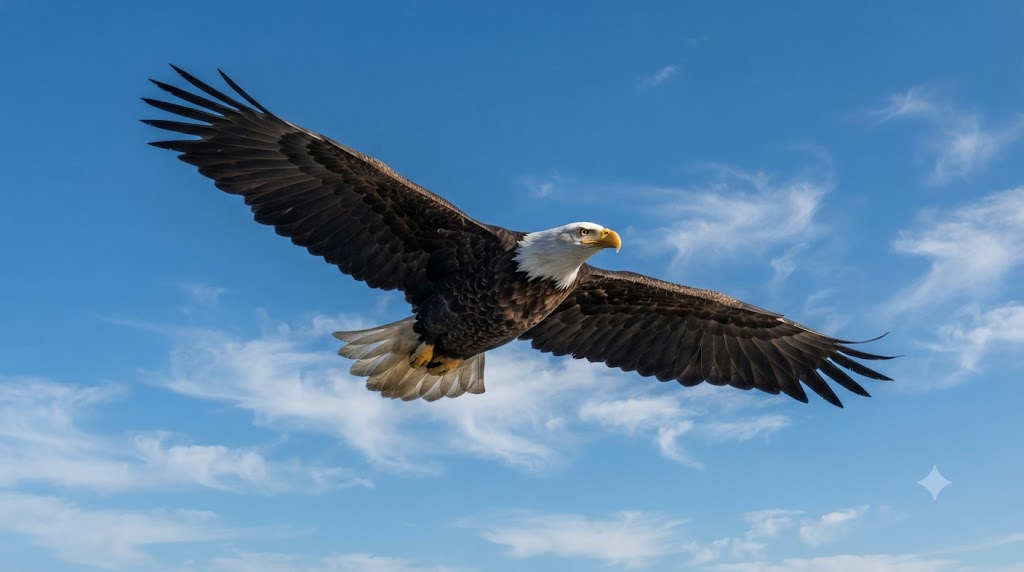
Bald Eagle vs. Golden Eagle: Adult Bald Eagles with pure white heads and tails are unmistakable. Juvenile Bald Eagles, however, are mottled brown and white; they can be separated from Golden Eagles by their massive, projecting heads (head projects more than half the tail length) and heavy yellow beaks. Golden Eagles have smaller, more proportionate heads, golden napes, and white wing patches restricted to the base of the primary flight feathers.
Turkey Vulture vs. Black Vulture: Turkey Vultures hold their two-toned wings (silvery flight feathers contrasting with dark wing linings) in a pronounced V-dihedral, rocking continually side-to-side in the wind. Black Vultures have short, squared tails, broad wings with silvery white patches restricted to the wingtips, and fly with several rapid, heavy flaps followed by a flat glide.
8. Comparative Flight Silhouette & Mechanics Matrix
| Raptor Group | Wing Shape & Length | Tail Proportion & Shape | Flight Style / Cadence | Primary Diagnostic Field Mark |
|---|---|---|---|---|
| Buteos (e.g. Red-tail) | Broad, rounded, slotted ‘fingers’ | Short, broad, fanned in soar | Steady soaring on thermals; powerful flaps | Patagial marks; broad wings; fan tail |
| Accipiters (e.g. Cooper’s) | Short, rounded, paddle-like | Very long, narrow, banded | Flap-flap-flap-glide rhythm | Cross or T-shaped silhouette; rapid woodland dash |
| Falcons (e.g. Peregrine) | Long, sharply pointed, swept back | Medium-long, narrow, tapered | Continuous, stiff, rapid rowing wingbeats | Pointed wingtips; dark facial helmet/mustache |
| Harriers (Northern Harrier) | Long, narrow, flexible wings | Long, narrow, squared tip | Buoyant, low quartering over grass; V-dihedral | Bright white rump patch; owl-like facial disk |
| Osprey | Long, narrow, bowed in M-shape | Medium, squared, barred | Flapping with deep strokes; hovering over water | Crooked M-wing angle; pure white underbody |
| Vultures (Turkey Vulture) | Long, broad, two-toned underside | Long, narrow, rounded | Continuous tippy, rocking glide in strong V | Strong dihedral; silvery flight feathers; red head |
9. Step-by-Step Raptor ID Protocol from Elevated Lookouts
When spotting a bird of prey approaching on the horizon, follow this rapid 4-step sequence:
- Assess Flight Style and Wing Angle: Is the bird soaring in circles, gliding in a straight line, or flapping continuously? Are the wings held completely flat, bowed downward, or raised in a V-shaped dihedral?
- Assign to Group Silhouette: Check wingtips (pointed vs. rounded/fingered) and tail length relative to wing width. Decide immediately: Buteo, Accipiter, Falcon, or Harrier?
- Check Proportional Head and Tail Ratios: Does the head project far forward like a Cooper’s Hawk or Bald Eagle, or is it recessed like a Sharp-shinned Hawk?
- Search for Underwing Plumage Marks: Look for dark patagial marks (Red-tail), underwing windows (Red-shouldered), black axillaries (Black-bellied Plover or Prairie Falcon), or two-toned trailing flight feathers (Turkey Vulture).
10. Frequently Asked Questions (FAQ)
Q1: What is a ‘kettle’ of hawks?
A kettle is a swirling flock of migrating raptors—most commonly Broad-winged Hawks, Swainson’s Hawks, or Turkey Vultures—concentrated inside a single rising thermal column. From a distance, the circling birds resemble bubbles rising and boiling in an enormous tea kettle.
Q2: Why are female raptors larger than males (reverse sexual dimorphism)?
Ornithologists hypothesize that reverse sexual size dimorphism allows a mated pair to hunt different prey sizes, reducing food competition within their breeding territory. Additionally, larger females can produce and incubate larger clutches of eggs while smaller, agile males specialize in catching fast songbirds for the family.
Q3: Can a Red-tailed Hawk lack a red tail?
Yes. All juvenile Red-tailed Hawks retain a brown tail marked with multiple narrow dark bands throughout their first year of life until their first complete pre-basic molt. However, their dark patagial underwing bars and streaked belly bands are present from the moment they leave the nest.
Q4: What is the best weather condition for visiting a hawk watch?
The most spectacular hawk migration days occur in autumn immediately following the passage of a strong cold front, characterized by crisp northerly or northwesterly winds, clear blue skies, and rising barometric pressure that generates powerful thermals and ridge lift.
Q5: How can I tell an immature Bald Eagle from a Golden Eagle?
Look at the head and bill proportions: a Bald Eagle has an enormous, protruding head that projects more than half the length of its tail and a massive bill. A Golden Eagle has a smaller, sleeker head and smaller bill. Immature Bald Eagles also display mottled white splotches across their belly and underwing linings, whereas young Golden Eagles have clean, crisp white patches strictly at the base of their primaries and the base of their tail.
11. Conclusion: Reading the Drama of High Skies
To stand atop a wind-swept ridgeline in autumn and watch hundreds of raptors glide silently south along mountain thermals is one of the grandest privileges in field natural history. By training your mind to look beyond surface colors and decipher the geometry of flight silhouettes, you unlock an exhilarating perspective on avian evolution and the untamed mastery of our planet’s greatest aerial predators.