THE BIRD IDENTIFICATION NOTEBOOK · FIELD GUIDE 02
Look Beyond the Feathers.
Learn to distinguish similar-looking birds through their silhouettes, proportions, movement, markings, and behavior.
◢
SHAPE
↝
MOVEMENT
◎
FIELD MARKS
Two birds can share almost the same colors, body size, and habitat while belonging to different species.
For beginner birdwatchers, this can make identification surprisingly challenging.
A small brown bird moving through a garden hedge may resemble several sparrow species. A distant waterbird may look similar to another species until you notice the shape of its bill or the way it moves.
Even experienced birdwatchers sometimes struggle to distinguish closely related birds.
The solution is to look beyond color alone.
Bird identification becomes more reliable when you combine several types of evidence, including body shape, movement, distinctive markings, location, and behavior.
Rather than trying to memorize every feather pattern, you can learn a practical observation process that helps narrow down possibilities.
This guide explains how to identify similar-looking birds using shape, movement, and field marks, with examples and exercises that beginners can practice during everyday birdwatching walks.
Why Do So Many Birds Look Alike?
Birds may look similar for several reasons.
Closely related species often share physical characteristics inherited through their evolutionary history.
Other birds may develop similar body shapes because they use comparable habitats or feeding strategies.
For example, many small insect-eating birds have narrow bills suited to capturing insects.
Several waterbirds have long legs and necks that help them move through shallow water.
Plumage can also create confusion.
Female birds, young birds, and individuals outside the breeding season may look substantially different from the brightly colored adults pictured in a field guide.
Lighting, distance, shadows, and feather wear can make identification even more difficult.
Understanding these limitations helps you avoid depending on a single visual clue.
THE FIRST RULE OF BIRD IDENTIFICATION
Shape first. Details second.
Begin by identifying the bird’s overall structure and likely group. Then use markings, movement, and habitat to distinguish between similar species.
1. Start With the Bird’s Overall Shape
Shape is one of the most useful clues because it can often be observed even when colors are difficult to see.
A bird’s outline, or silhouette, reveals information about its body proportions.
Notice whether the bird appears round or slender, upright or horizontal, compact or long-bodied.
Also consider how its head, wings, tail, and legs relate to the rest of its body.
Body Size and Proportions
Try comparing an unfamiliar bird with a species you already recognize.
Is it smaller than a typical pigeon? Similar in size to a sparrow? Larger than a crow?
Relative comparisons are often more useful than estimating exact measurements.
Distance can make a large bird appear smaller, so avoid relying on size alone unless you have a reliable reference.
Head Shape
Look at the shape and relative size of the head.
Some birds have rounded heads, while others appear flatter, more elongated, or crested.
Head shape can be an important clue when comparing similar ducks, songbirds, and birds of prey.
Remember that posture and raised feathers can temporarily change a bird’s outline.
Wing and Tail Proportions
Observe where the folded wings end relative to the tail.
Are the wings short and rounded, or long and pointed?
Is the tail narrow, broad, square-ended, rounded, or forked?
These characteristics can help distinguish bird groups and sometimes individual species.
2. Study the Shape of the Bill
A bird’s bill can provide important clues about its feeding habits and identity.
Different species may have similar colors but noticeably different bill proportions.
When observing a bird, consider the bill’s length, thickness, curvature, and overall shape.
| Bill Shape | Common Function | Example Bird Group |
|---|---|---|
| Short and thick | Handling or cracking seeds | Many finches |
| Thin and pointed | Capturing small insects | Many warblers |
| Long and spear-like | Capturing aquatic prey | Herons |
| Strong and hooked | Tearing food | Many birds of prey |
| Long and probing | Finding food in mud or sand | Many shorebirds |
These are broad patterns, not rules that identify a species by themselves.
Closely related birds may have only subtle differences in bill length or thickness.
Compare the bill with the size of the bird’s head rather than judging its length in isolation.
3. Observe How the Bird Moves
Bird behavior can provide clues that are difficult to capture in photographs.
Some birds walk steadily across the ground, while others hop between branches.
Others climb tree trunks, flick their tails, hover briefly, or repeatedly fly from a perch to catch insects.
These actions may help narrow the identification when two birds appear visually similar.
Walking and Hopping
Watch how the bird travels along the ground.
Does it walk with alternating steps, move in short hops, or run quickly?
Observe its posture while feeding and whether it frequently pauses to scan its surroundings.
Movement patterns are helpful clues, although a single species may use more than one method.
Climbing and Foraging
Some birds search for food along trunks and branches.
Others spend most of their feeding time among leaves, on the ground, or over open water.
Notice whether the bird moves upward along a tree, probes bark, searches foliage, or captures insects in flight.
Tail Movement
Tail movements can be particularly useful.
Some species repeatedly flick, pump, wag, or spread their tails.
Record the direction and rhythm of the movement rather than simply writing that the bird was active.
For example, the frequent tail-dipping behavior of many phoebes can help distinguish them from some other small flycatchers.
4. Pay Attention to Flight Patterns
Flight style offers another opportunity to distinguish similar-looking birds.
Some birds fly with rapid, continuous wingbeats.
Others alternate flapping and gliding or soar with their wings extended.
Observe the shape of the wings, the length of the tail, and how the bird changes direction.
Wingbeat Rhythm
Notice whether the wingbeats appear fast, slow, shallow, or deep.
Different species may show characteristic rhythms, especially during sustained flight.
Gliding and Soaring
Some birds of prey and other large birds spend extended periods soaring or gliding.
Wing shape, posture, and tail outline can be important for distinguishing distant birds.
Neck Position in Flight
Neck posture can help distinguish some large waterbirds.
For example, herons and egrets typically fly with their necks folded into an S-shaped position, while cranes generally fly with their necks extended.
This distinction can be more useful at a distance than apparent body color.
5. Learn the Most Important Field Marks
Field marks are visible features that help distinguish a bird from similar species.
They may include distinctive patterns around the eyes, markings on the wings, streaks across the chest, or contrasting patches on the tail.
Learning a few common field-mark terms makes bird guides easier to understand.
Field Marks to Look For
Eye ring: A light or contrasting ring of feathers around the eye.
Eye stripe: A line or band passing through or near the eye.
Supercilium: An eyebrow-like stripe above the eye.
Wing bars: Contrasting bands across the folded wing.
Breast streaking: Narrow lines or streaks on the chest or underside.
Throat patch: A distinctive area of color beneath the bill.
Tail pattern: Contrasting colors, outer tail feathers, or visible bands.
Not every bird has all these features, and some markings change with age, sex, season, or feather wear.
When you notice a field mark, record both its appearance and location.
For example, “two pale wing bars” is more useful than simply writing “white markings.”
Avoid relying on one field mark when other available evidence conflicts with it.
6. Understand Why Color Can Be Misleading
Bird colors are often the first features people notice, but they are not always the most reliable identification clues.
Lighting can significantly change how plumage appears.
A brown bird may look nearly black against bright sunlight.
Colors may appear warmer in evening light or less saturated in cloudy conditions.
Birds also change appearance as they grow and molt.
In some species, males and females have different plumage.
Immature birds may lack the distinctive adult markings shown in popular identification photographs.
Seasonal plumage changes create further variation.
Instead of focusing only on exact shades, look for the arrangement of contrasting colors.
A dark cap, pale eyebrow, striped breast, or white outer tail feathers may remain recognizable even when lighting changes.
7. Compare Similar-Looking Birds in Practice
Practical comparisons help demonstrate how multiple identification clues work together.
The following examples are region-specific and are intended to teach an observation method rather than serve as complete identification keys.
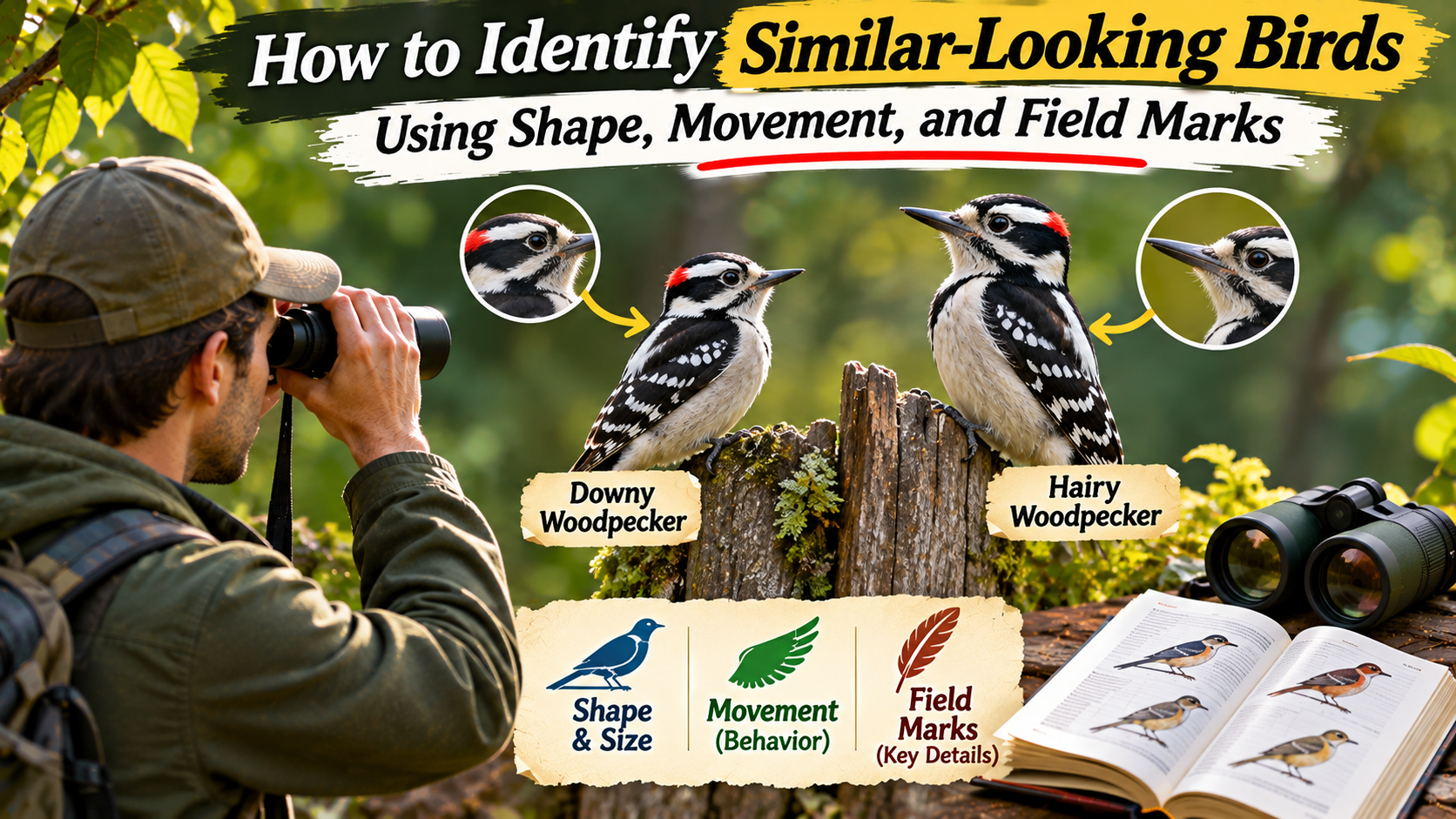
Downy Woodpecker vs. Hairy Woodpecker
These two North American woodpeckers share black-and-white plumage patterns and similar behavior.
They can be difficult to distinguish when observed separately.
The Hairy Woodpecker is generally larger and has a proportionally longer bill.
The Downy Woodpecker typically has a shorter bill relative to its head.
Instead of relying on color, compare the bill length, overall body size, and proportions.
Other field marks may help, but visibility and regional variation should be considered.
Willow Warbler vs. Common Chiffchaff
These small birds can appear remarkably similar in parts of Europe.
Both have subtle greenish-brown plumage and pale underparts.
Calls and songs are often especially useful for distinguishing them.
Willow Warblers typically have a flowing, descending song, while Common Chiffchaffs are known for their repeated two-note song pattern.
Wing proportions and other structural clues can help, but features such as leg color vary and should not be treated as definitive by themselves.
Snowy Egret vs. Great Egret
In North America, these white wading birds can create confusion for beginners.
Great Egrets are substantially larger and have longer overall proportions.
Adult Snowy Egrets commonly show black bills and conspicuous yellow feet, while adult Great Egrets generally have yellow bills and black feet during typical nonbreeding conditions.
Bill colors can vary seasonally and with age, so size and structure should also be considered.
These comparisons demonstrate why combining several clues is more reliable than choosing a species based on color alone.
8. Use Habitat and Location to Narrow the Possibilities
Habitat provides valuable context for bird identification.
Some birds are strongly associated with woodland, grassland, wetlands, coastal areas, or open farmland.
Others are adaptable and occur in several different environments.
When you observe an unfamiliar bird, note the surrounding habitat.
Was it perched in a tree, walking through shallow water, feeding on an open lawn, or moving through dense shrubs?
Location also matters.
A bird commonly found in one region may be very unusual in another.
Seasonal migration changes which species are likely to be present.
Use regional field guides and current local bird records to check whether a possible identification makes sense geographically.
Remember that unusual sightings do occur, so habitat and range are supporting evidence rather than absolute proof.
9. Listen to Songs and Calls
Bird sounds can distinguish species that are difficult to separate visually.
Many birds produce recognizable calls or songs, although vocalizations vary with context, age, and region.
When a bird vocalizes, listen for several characteristics.
- Is the sound a whistle, chirp, trill, buzz, or harsh call?
- Does it rise or fall in pitch?
- Is the phrase repeated regularly?
- Does the bird produce one note or a longer sequence?
- Are several birds calling together?
Record a short description in your notebook.
If appropriate, you can make a passive audio recording for later comparison.
Avoid playing recorded bird calls to attract birds, especially around nesting territories or sensitive species, because playback may disturb their behavior.
10. Record Field Notes Before the Bird Disappears
Birds rarely remain still long enough for unlimited observation.
When you encounter an unfamiliar bird, focus first on the details most likely to help later.
A short, structured note can be more useful than a long description written from memory.
FIELD OBSERVATION RECORD
A Sample Identification Note
Location: Woodland edge near a public park
Approximate size: Small songbird
Shape: Slender body, thin pointed bill
Color pattern: Olive-brown upperparts, pale underside
Movement: Moving rapidly between branches
Sound: Short repeated calls, not clearly recorded
Identification: Small insect-eating songbird; species not confirmed
This fictional example shows how to record useful evidence without making an unsupported identification.
A Simple Bird Identification Checklist
Use the following sequence whenever you encounter an unfamiliar bird.
| Step | What to Check | Question to Ask |
|---|---|---|
| 1 | Overall shape | Is the bird round, slender, or long-bodied? |
| 2 | Bill and tail | What are their proportions and shapes? |
| 3 | Movement | Does it hop, walk, climb, or fly in a distinctive way? |
| 4 | Field marks | Are there eye stripes, wing bars, or other patterns? |
| 5 | Habitat and season | Which species are plausible here and now? |
| 6 | Sound and notes | Can I record additional evidence? |
Common Mistakes When Identifying Similar Birds
Even careful observers can make mistakes.
The following habits are especially common among beginners:
- Depending only on color: Lighting and plumage variation can make colors unreliable.
- Ignoring proportions: Bill length, tail shape, and body structure may be more useful than general appearance.
- Assuming one behavior proves identification: Many species share movements and feeding habits.
- Forgetting the date and location: Range and season help evaluate possible species.
- Trusting a single photograph: One angle may hide important identification features.
- Choosing a species too quickly: A confident but unsupported identification is less useful than a careful uncertain record.
Try comparing at least two or three independent clues before confirming a difficult species.
How to Practice Bird Identification Skills
Consistent observation is one of the best ways to improve.
Start with common birds in a familiar location.
Notice how their silhouettes look from different angles.
Observe the way they walk, perch, feed, and fly.
Over time, these familiar species become useful reference points when you encounter an unfamiliar bird.
You can also compare photographs in a regional field guide, paying attention to both structure and plumage.
When possible, study videos to learn movements that still photographs cannot show.
Review your field notes after each outing and identify which characteristics were most useful.
For a difficult sighting, compare several possible species rather than searching only for photographs that resemble your first guess.
Frequently Asked Questions
What is the easiest way to identify similar-looking birds?
Start with overall shape and size, then compare bill proportions, movement, field marks, habitat, and sounds. Using several clues together is more reliable than relying on color alone.
Why is bird shape important for identification?
Shape reveals structural characteristics such as head size, body proportions, wing length, bill shape, and tail outline. These features can help narrow down the possible species.
What are field marks in birdwatching?
Field marks are distinctive visual features, such as eye rings, wing bars, breast streaks, throat patches, and contrasting tail patterns, that help distinguish similar birds.
Can birds be identified by their movements?
Movement can provide useful clues, including tail flicking, climbing behavior, feeding methods, and flight style. However, behavior should be considered alongside other evidence.
Why do birds of the same species sometimes look different?
Appearance can vary with age, sex, season, molt, individual differences, and lighting conditions. Some species show especially noticeable changes in plumage.
What should I do if I cannot identify a bird?
Record the features you observed and compare them with regional identification resources later. It is acceptable to leave a sighting unidentified when the evidence is insufficient.
Do I need binoculars to identify birds?
Binoculars can reveal distant details, but beginners can practice recognizing silhouettes, movement, and behavior without specialized equipment.
Final Thoughts
Identifying similar-looking birds becomes easier when you develop a systematic observation method.
Begin by noticing the bird’s overall shape and proportions.
Study its bill, wings, tail, and posture.
Observe how it moves, feeds, and flies.
Then compare distinctive field marks, vocalizations, and habitat information.
Do not worry if some birds remain unidentified.
Birdwatching is a skill that improves through repeated observation, careful comparison, and a willingness to learn from uncertainty.
As you become familiar with common species, subtle differences in structure and behavior will become easier to notice.
The most valuable habit is simple: spend a little more time observing before deciding what you have seen.
THE BIRD IDENTIFICATION FORMULA
Shape + Movement + Field Marks + Habitat = Stronger Identification
The more independent clues you observe, the better your chances of distinguishing birds that initially appear almost identical.