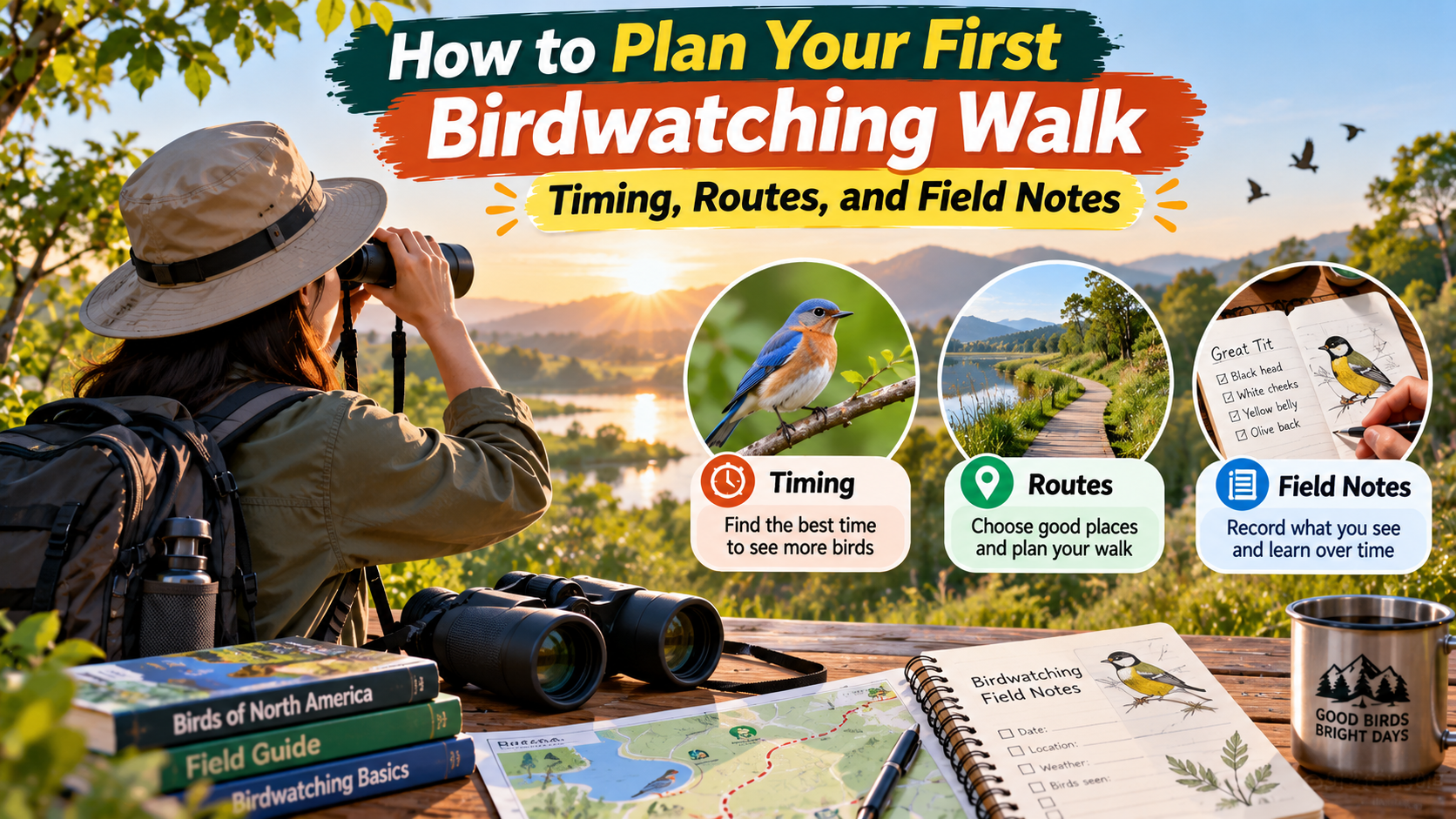
THE NATURE EXPLORER · FIELD JOURNAL 01
Your First Birdwatching Walk Starts Here.
A practical guide to choosing the right time, finding a comfortable walking route, observing birds responsibly, and keeping useful field notes.
A Simple Nature Walk Plan
☀️
TIMING
🌿
ROUTES
📓
FIELD NOTES
Birdwatching is one of the most accessible ways to explore the natural world.
You do not need to travel to a remote forest, purchase expensive equipment, or recognize dozens of bird species before beginning.
A neighborhood park, riverside path, woodland trail, or quiet garden can provide opportunities to observe birds and learn about their behavior.
However, your first birdwatching walk can feel more rewarding when you plan a few details in advance.
Choosing the right time of day, selecting a manageable route, and preparing a simple method for recording observations can make the experience easier and more enjoyable.
Good planning also helps you avoid unnecessary disturbance to wildlife and stay comfortable outdoors.
This guide explains how to organize your first birdwatching walk, what to bring, where to look, and how to record useful field notes.
What Is a Birdwatching Walk?
A birdwatching walk is an outdoor activity focused on observing birds in their natural or everyday environments.
It combines gentle exploration with careful attention to movement, sound, habitat, and behavior.
Unlike a walk focused mainly on distance or exercise, birdwatching encourages you to slow down.
You may stop frequently to listen, scan trees, or observe birds feeding.
The goal is not necessarily to identify every species.
For beginners, learning to notice birds and describe their characteristics is already meaningful progress.
Over time, repeated observations can improve your ability to recognize common species by appearance, movement, and sound.
Beginner’s Tip
Focus on observation before identification.
Notice a bird’s size, shape, colors, movements, and sounds. These details are useful even when you cannot immediately identify the species.
Step 1: Choose the Best Time for Birdwatching
Timing can influence how many birds you notice and how active they appear.
Bird activity varies by species, season, weather, and habitat.
Nevertheless, some general patterns can help beginners plan their first walk.
Early Morning
Early morning is often a productive time for observing many daytime bird species.
Birds may be actively feeding, moving between locations, or calling to communicate.
During the breeding season, some species are particularly vocal in the morning.
This makes the period shortly after sunrise a useful starting point for many birdwatching walks.
However, the exact timing depends on local conditions.
Late Afternoon
Late afternoon can also provide opportunities to observe birds.
Some species become more active as temperatures begin to cool.
This period may be especially comfortable during warmer months.
Be sure to allow enough daylight to complete your route safely.
Midday
Midday birdwatching can still be worthwhile.
Although some birds may be less active during hot weather, you can observe species that remain visible throughout the day.
Waterbirds, soaring birds, and birds using shaded habitats may provide interesting observations.
The most important factor is choosing a time that is comfortable and practical for you.
Step 2: Consider the Season
Birdwatching opportunities change throughout the year.
Some species remain in the same area year-round.
Others migrate between breeding and wintering regions.
Seasonal changes can also affect bird behavior and visibility.
Spring
In many temperate regions, spring brings increased singing, nesting activity, and the arrival of migratory birds.
It can be a rewarding season for learning bird songs and observing territorial behavior.
Always avoid approaching nests or disturbing breeding birds.
Summer
Summer may provide opportunities to observe young birds and family groups.
Warm weather can make early morning walks more comfortable than midday outings.
Autumn
Autumn migration can bring changes in the bird species present in an area.
Some locations become important stopover sites for migrating birds.
Winter
Winter birdwatching can be productive, particularly near wetlands, open water, and places where seasonal visitors gather.
In colder regions, reduced foliage may make some birds easier to see.
Seasonal patterns vary substantially between countries and hemispheres, so use local birding resources to understand the best periods in your area.
Step 3: Select a Beginner-Friendly Route
Your first birdwatching route does not need to be long or physically demanding.
A short, familiar route often provides a better introduction than an ambitious hike.
Choose a place where you can move comfortably, stop safely, and observe without disturbing wildlife.
Good beginner locations include:
- Public parks with trees and open spaces.
- Nature reserves with marked walking trails.
- Wetland boardwalks and designated viewing areas.
- Woodland paths with accessible entrances.
- Riverside or lakeside walking routes.
- Quiet neighborhood green spaces.
Consider the length, surface, accessibility, and available facilities before choosing a route.
For your first outing, a route of approximately 30 to 60 minutes may be manageable, depending on your comfort and mobility.
Remember that birdwatching involves frequent stops, so you may cover less distance than during an ordinary walk.
Step 4: Look for Different Bird Habitats
Different habitats attract different bird species.
Learning to recognize habitat types can help you decide where to spend time observing.
Woodlands and Forest Edges
Trees provide shelter, nesting locations, and feeding opportunities for many birds.
Forest edges can be particularly interesting because they combine different vegetation types.
Look for movement among branches and listen for calls coming from different heights.
Wetlands and Lakes
Wetlands can support ducks, herons, waders, and other water-associated birds.
Designated viewing platforms and boardwalks may offer useful observation points.
Stay on permitted paths and avoid approaching sensitive nesting or feeding areas.
Grasslands and Open Fields
Open habitats can provide opportunities to observe birds feeding on the ground or flying above vegetation.
Scan fence posts, shrubs, and distant trees where birds may perch.
Urban Parks and Gardens
Urban green spaces are excellent starting points because they are often accessible and familiar.
Even common birds can teach beginners valuable identification and observation skills.
Step 5: Check the Weather Before Leaving
Weather affects both bird activity and personal comfort.
Before your walk, review the local forecast.
Check the temperature, chance of rain, wind conditions, and expected daylight.
Calm weather may make it easier to hear bird calls and notice movement in vegetation.
Strong winds can make observation more difficult, particularly in exposed areas.
Rain may reduce visibility and create slippery walking conditions.
However, light rain does not always prevent bird activity.
Choose conditions appropriate for your experience and equipment.
Avoid walking during thunderstorms, dangerous winds, extreme temperatures, or other severe weather.
Step 6: Pack a Simple Birdwatching Kit
You do not need a large collection of equipment to enjoy your first birdwatching walk.
Start with practical items that support observation and comfort.
| Item | Purpose | Essential? |
|---|---|---|
| Comfortable shoes | Safe walking on the chosen route | Yes |
| Water | Staying hydrated | Yes |
| Notebook and pencil | Recording observations | Recommended |
| Binoculars | Viewing distant birds | Optional |
| Field guide or identification app | Comparing bird characteristics | Optional |
| Weather-appropriate clothing | Comfort and protection | Yes |
| Phone or map | Navigation and emergencies | Recommended |
If you already own binoculars, bring them.
If not, begin by observing birds with your eyes and ears.
Learning to notice movement and behavior is valuable even without magnification.
Step 7: Learn How to Observe Birds
Birdwatching involves more than searching for colorful feathers.
Many birds are easier to detect through sound or movement than through direct visual observation.
Walk slowly and pause regularly.
Listen for calls, songs, rustling leaves, or wing movements.
Scan different levels of vegetation, including the ground, shrubs, and tree canopies.
When you notice a bird, avoid sudden movements.
Observe from a comfortable distance and allow the bird to continue its natural behavior.
Notice Size and Shape
Try to estimate whether the bird is small, medium-sized, or large compared with familiar species.
Observe the shape of its body, tail, wings, and beak.
Look for Distinctive Markings
Pay attention to visible colors, stripes, spots, and patterns.
Remember that lighting conditions can affect how colors appear.
Watch Behavior
Behavior can provide useful identification clues.
Some birds spend time on the ground, while others move rapidly through branches.
Notice whether a bird is feeding, calling, perching, or flying.
Listen Carefully
Bird songs and calls can help with identification.
Beginners can start by describing the sound rather than attempting to memorize every species.
For example, you might record a repeated whistle, a short chirping sequence, or a harsh call.
Step 8: Keep Useful Birdwatching Field Notes
Field notes help you remember what you observed and improve your identification skills over time.
They do not need to be complicated.
A small notebook is enough for recording the most important details.
Useful information includes the date, time, location, weather, habitat, and bird characteristics.
You can also record behavior and sounds.
If you are uncertain about a species, write down what you actually observed rather than making a confident guess.
Field Journal — Sample Entry
Date: April 12
Time: 7:30 AM
Location: Local park near a pond
Weather: Cool, partly cloudy, light breeze
Observation: Medium-sized bird with a long neck standing near shallow water
Behavior: Walking slowly and searching for food
Identification: Not confirmed; compare notes with a field guide later
This is a fictional example showing how a beginner might organize field notes.
How to Identify Birds After Your Walk
You do not need to identify every bird while standing outdoors.
Sometimes it is better to focus on observing carefully and review your notes afterward.
Compare the details you recorded with a regional bird field guide or a reliable identification resource.
Look for similarities in body shape, habitat, markings, and behavior.
Pay attention to the geographic range of possible species.
A bird that is common in one country may be rare or absent in another.
Season can also influence which species are likely to be present.
If you remain uncertain, record the bird as unidentified.
Accurate uncertainty is more useful than an unsupported identification.
Responsible Birdwatching and Wildlife Protection
Birdwatching should not interfere with the birds you are observing.
Wildlife welfare should always come before obtaining a closer view or photograph.
Remain on designated paths where required.
Avoid approaching nests, eggs, or young birds.
Do not chase birds or repeatedly disturb them to obtain better photographs.
Keep noise at a reasonable level.
Follow local rules concerning protected habitats and wildlife.
Be especially cautious around breeding colonies and sensitive species.
If a bird changes its behavior because of your presence, move farther away.
Wildlife First
Observe without disturbing.
A successful birdwatching walk respects the natural behavior, habitats, and safety of the birds being observed.
Personal Safety During a Birdwatching Walk
Birdwatching is generally a low-impact outdoor activity, but basic preparation is important.
Choose routes appropriate for your physical abilities and experience.
Check whether trails are open and accessible.
Carry water and wear footwear suitable for the terrain.
Use sun protection or warm clothing when conditions require it.
Be aware of local wildlife, insects, and environmental hazards.
If you are visiting an unfamiliar location, consider telling someone your planned route and expected return time.
Avoid entering restricted areas or walking into unsafe terrain to follow a bird.
For wetland and coastal routes, pay attention to changing water levels, tides, and local warnings.
A Sample 60-Minute Birdwatching Walk
A short plan can help beginners organize their time without turning the outing into a rigid schedule.
| Time | Activity | Goal |
|---|---|---|
| 0–10 minutes | Walk slowly and listen | Notice nearby bird sounds |
| 10–25 minutes | Observe trees and shrubs | Practice spotting movement |
| 25–40 minutes | Visit an open area or water feature | Compare birds in different habitats |
| 40–50 minutes | Pause and record observations | Complete field notes |
| 50–60 minutes | Return along the planned route | Review sounds and sightings |
Adjust this schedule according to your route, weather, and personal comfort.
It is perfectly reasonable to spend most of the walk observing one interesting bird.
Common Beginner Birdwatching Mistakes
Many first-time birdwatchers expect to see numerous unusual species immediately.
However, successful birdwatching is more about careful observation than the number of birds recorded.
Common mistakes include:
- Walking too quickly: Moving rapidly can make subtle bird activity harder to notice.
- Choosing an overly long route: Fatigue can reduce concentration and enjoyment.
- Ignoring bird sounds: Many birds are detected by hearing before they are seen.
- Trying to identify everything immediately: This can distract from useful observations.
- Forgetting field notes: Details may be difficult to remember later.
- Approaching birds too closely: This can disturb natural behavior.
- Expecting rare sightings: Common birds are excellent subjects for learning.
Recognizing these mistakes early can help make future walks more comfortable and productive.
How to Improve After Your First Walk
After returning home, review your notes.
Consider which habitats produced the most interesting observations.
Think about whether the timing and route were comfortable.
Identify one or two skills you would like to improve.
For example, you might practice recognizing bird silhouettes or learning the calls of common local species.
Returning to the same location regularly can be particularly useful.
Repeated visits help you notice seasonal changes and become familiar with the birds that use the area.
Over time, your field notes can become a personal record of local wildlife activity.
Frequently Asked Questions About Birdwatching Walks
What is the best time of day for birdwatching?
Early morning is often productive for observing many daytime birds, although activity varies by species, season, weather, and habitat.
How long should my first birdwatching walk be?
A walk of approximately 30 to 60 minutes can be a manageable starting point. Choose a duration that suits your comfort and mobility.
Do I need binoculars for birdwatching?
No. Binoculars can improve distant views, but beginners can learn valuable observation skills without them.
Where should beginners go birdwatching?
Public parks, gardens, accessible nature reserves, woodland paths, and designated wetland viewing areas are useful starting locations.
What should I write in a birdwatching notebook?
Record the date, time, location, weather, habitat, bird appearance, sounds, and behavior. Include uncertainty when identification is not confirmed.
Can I go birdwatching in winter?
Yes. Winter can provide interesting birdwatching opportunities, particularly where seasonal visitors or waterbirds are present.
How can I avoid disturbing birds?
Keep a respectful distance, remain on permitted paths, avoid approaching nests, and allow birds to continue their natural behavior.
Final Thoughts
Your first birdwatching walk does not need to be complicated.
Choose a comfortable time, select an accessible route, and bring a few practical supplies.
Move slowly, listen carefully, and observe the birds you encounter without disturbing them.
Simple field notes can help you remember sightings and improve your identification skills over time.
Most importantly, enjoy the process of discovering the wildlife around you.
Even a short walk through a familiar park can reveal details that are easy to overlook during everyday activities.
Birdwatching rewards patience, curiosity, and repeated observation.
Start close to home, keep your expectations flexible, and let each walk teach you something new about the natural world.
Your First Walk Checklist
Choose a Time. Plan a Route. Observe Carefully. Record What You See.
The best birdwatching walk is one that helps you explore nature comfortably, safely, and with respect for wildlife.