🌿 Quick Article Overview
Birdwatching—often affectionately termed “birding”—is one of the fastest-growing outdoor naturalist activities worldwide. It combines ecological observation, mindfulness, outdoor exploration, and citizen science. Whether you are stepping into your local municipal park or traveling to remote wetland sanctuaries, cultivating keen field observation skills, patience, and ethical discipline transforms occasional sightings into a lifelong naturalist journey.
- Foundational habits: slow movement, peripheral scanning, and silence
- Understanding avian activity cycles and seasonal micro-movements
- Field sketch notes and documentation best practices
- Ethical guidelines for non-intrusive wildlife observation
Table of Contents
- The Philosophy and Joy of Modern Birdwatching
- Core Field Habits: How to Move, Look, and Listen in Nature
- Circadian Rhythms: When and Where Birds are Most Active
- Essential Field Note Taking and Real-Time Observation Protocols
- Comparative Analysis of Birding Environments
- Step-by-Step Field Exercise for Novice Birders
- The Birder’s Code of Ethics: Safeguarding Wild Avian Populations
- Frequently Asked Questions (FAQ)
- Conclusion and Lifelong Practice
1. The Philosophy and Joy of Modern Birdwatching
Birdwatching is far more than simply ticking names off a personal checklist or compiling a competitive life list. At its core, birding is an active exercise in sensory awakening and ecological literacy. Birds are omnipresent indicators of environmental health; their presence, songs, reproductive vigor, and migratory schedules reflect the underlying vitality of terrestrial and aquatic ecosystems. When an observer pauses to watch a White-breasted Nuthatch spiraling headfirst down the bark of an ancient oak, they are witnessing millions of years of specialized evolutionary adaptation unfolding in real time.
In our increasingly digital, high-velocity world, spending dedicated hours outdoors immersed in avian observation provides demonstrable psychological restoration. Ornithological research and eco-psychology studies consistently confirm that tuning into bird activity lowers cortisol levels, improves cognitive focus, and cultivates an enduring appreciation for local biodiversity. By training the mind to notice subtle twitches among trembling foliage, distant chipping notes, and rapid flight silhouettes against the horizon, birdwatchers develop an acute awareness that fundamentally redefines how they interact with the natural landscape.
Furthermore, modern birding represents one of the largest collaborative citizen-science initiatives on the planet. Through platforms like eBird, birders globally contribute millions of field observations annually. These verified records enable professional conservation biologists, climatologists, and wildlife managers to track species distribution shifts, population declines, and altered migratory timetables brought about by habitat fragmentation and global climate change. Every quiet morning spent in the field thus carries tangible scientific value.
💡 Naturalist Insight
When beginning your birding journey, avoid the urge to rush between locations. Quiet, prolonged stillness in a single promising edge habitat frequently produces ten times more sightings than rapid hiking along marked trails.
2. Core Field Habits: How to Move, Look, and Listen in Nature
The difference between a casual stroller who notices few birds and an accomplished field observer lies almost entirely in technique and habit. Wild birds possess sensory systems optimized over millennia to detect predators. Sudden jerky gestures, high-contrast synthetic garments, crunching footfalls, and loud vocalizations trigger immediate flight responses across forest canopies and reed beds alike.
A. The Art of Gliding Movement and Silhouette Concealment
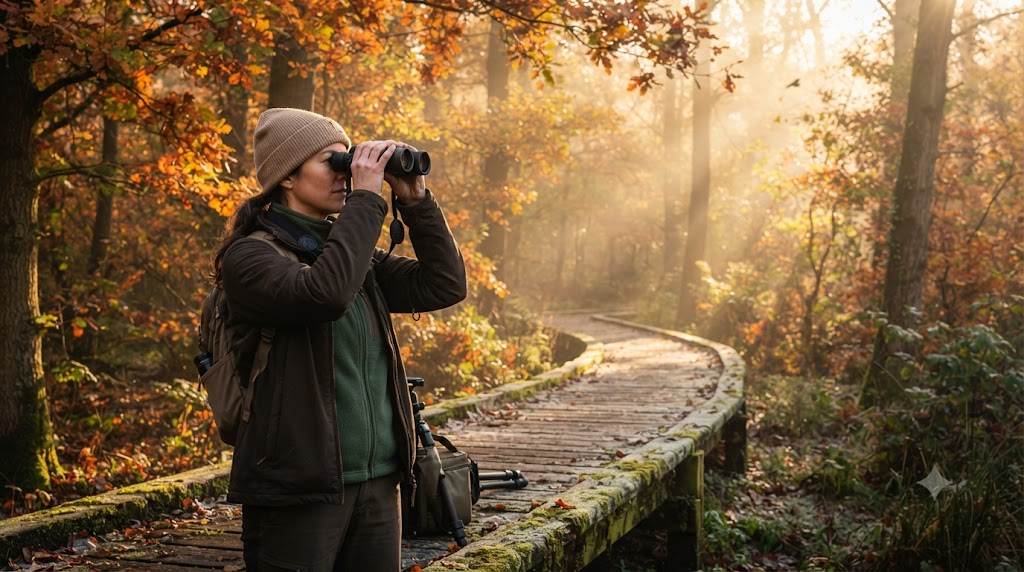
When traversing a woodland trail or marsh boardwalk, adopt a deliberate, rhythmic gait known among field naturalists as the “heron stalk.” Step gently from the outside edge of the heel through to the ball of the foot, allowing your weight to settle smoothly rather than striking the ground heavily. Keep your arms close to your torso; extending binoculars or pointing excitedly with an outstretched arm creates an exaggerated horizontal profile that birds interpret as an imminent raptor attack or predator strike.
Utilize natural cover whenever possible. Position your body against tree trunks, under overhanging branches, or along hedgerows rather than standing exposed in open clearings or silhouetted against a bright ridgeline. By breaking up your human outline and wearing muted earth tones—such as olive greens, neutral tans, dull browns, and slate grays—you become an unobtrusive element of the forest backdrop rather than an alarming intruder.
B. Training the Eyes: Peripheral Scanning vs. Tunnel Vision
Beginner birders frequently make the mistake of staring intently at individual leaves hoping a colorful bird will materialize. Seasoned birders, by contrast, employ soft-focus peripheral scanning. By relaxing your central vision and taking in broad swaths of the canopy or shrub layer, your peripheral retina—which is exceptionally sensitive to subtle motion—will instantly flag unnatural tremors, flicking tails, or fluttering wings. Once motion is detected, you can seamlessly bring your binoculars to your eyes without moving your head.
💡 Field Tip: The Gaze Lock Technique
Always lock your naked eyes onto the exact branch or twig where the bird is perched before raising your binoculars. Never look down at your binoculars; raise the optical barrels directly into your established line of sight to lock onto the subject instantly.
3. Circadian Rhythms: When and Where Birds are Most Active
Bird activity across all ecosystems is heavily governed by sunlight, ambient temperature, humidity, and atmospheric pressure. Understanding these circadian and meteorological patterns allows you to optimize your outings for maximum species richness and behavioral observations.
The golden period of birding begins approximately thirty minutes before official sunrise and extends for roughly three to four hours. During this interval—frequently termed the “dawn burst”—passerines (songbirds) awaken with urgent caloric needs following overnight fasting. Insects become active as moisture evaporates from foliage, and thermal conditions provide crisp acoustic transmission for territorial singing and courtship displays.
As midday approaches and ambient temperatures peak, avian metabolism shifts. Most woodland songbirds retreat deep into shaded interior canopies or dense thickets to conserve hydration, preen plumage, and avoid high thermal stress. During these quiet afternoon lulls, however, soaring raptors—such as Buteo hawks, vultures, and eagles—take advantage of rising thermal columns to circle effortless miles without flapping. A second, gentler peak of songbird activity frequently recurs during the late afternoon (roughly two hours prior to dusk) as birds forage voraciously to build overnight energy reserves.
4. Essential Field Note Taking and Real-Time Observation Protocols
In an era dominated by smartphone applications, the tactile discipline of maintaining a physical field notebook remains the ultimate accelerator of ornithological competence. Writing down specific morphological marks, structural proportions, and habitat nuances forces your brain to critically analyze what your eyes are observing rather than relying on passive cognitive recognition.
When documenting an unfamiliar bird in the wild, record your observations following a rigorous top-down anatomical sequence before opening a field guide:
- Overall Silhouette & Proportions: Is the body plump or streamlined? Is the tail notched, squared, rounded, or wedge-shaped? How does head size compare to overall body mass?
- Bill Morphology: Is the bill stout and conical (granivore), slender and pointed (insectivore), hooked at the tip (carnivore), or spatulate (filter-feeder)?
- Facial Markings: Note eye rings, superciliary lines (eyebrow stripes), transocular lines (stripes through the eye), malar stripes (mustache marks), and crown patterns.
- Wing & Tail Patterning: Look for distinct wing bars, primary feather projection, and white outer tail feathers flashed during take-off.
- Behavioral Subtleties: Does it pump its tail continuously while perched? Does it glean insects from underneath leaves, or sallies out into open air like a flycatcher?
5. Comparative Analysis of Birding Environments
Different biological ecosystems demand tailored observation techniques. The table below outlines key habitats, characteristic avian families, and recommended tactical approaches for maximizing detection rates:
| Habitat Type | Target Bird Families | Prime Time Window | Recommended Field Technique |
|---|---|---|---|
| Deciduous Hardwood Forest | Warblers, Vireos, Woodpeckers, Tanagers | Sunrise to 10:30 AM | Slow trail walking, scanning middle canopy, pishing at dense bramble edges |
| Freshwater Marsh / Wetland | Rails, Bitterns, Herons, Waterfowl | Dawn and Sunset | Stationary viewing from observation towers or blinds with spotting scope |
| Coastal Mudflats / Estuary | Plovers, Sandpipers, Gulls, Terns | Mid-tide (rising or falling) | Scanning shoreline edge where feeding substrates are actively exposed |
| Grasslands & Open Meadows | Sparrows, Meadowlarks, Harriers, Bobolinks | Early morning before wind rises | Tracking flight displays, scanning fence posts and elevated weed stalks |
| Suburban Gardens & Parks | Finches, Titmice, Thrashers, Hummingbirds | All day (peaks at dawn) | Maintaining backyard feeder stations and bird baths near native shrubbery |
6. Step-by-Step Field Exercise for Novice Birders
To rapidly transition from theoretical knowledge to practical field competence, execute this structured 60-minute “Sit-and-Wait” field exercise once weekly in a local green space:
Step 1: Select an Ecotone Boundary (Minutes 0–10)
Locate an “ecotone”—the transitional boundary where two distinct habitats meet, such as where an old-growth forest borders an overgrown meadow, or where a riparian willow thicket meets an open pond. Ecotones naturally concentrate high avian diversity due to the rich variety of food resources and nesting structures. Sit quietly on a log or folding stool with the sun at your back so lighting illuminates incoming birds rather than glaring into your optics.
Step 2: Acoustic Baseline Mapping (Minutes 10–25)
Close your eyes for five minutes to recalibrate your auditory senses. Identify the distinct ambient soundscape layers: wind in foliage, running water, and distant vehicular traffic. Once baseline noises are mentally filtered, note the direction, distance, and pitch of every distinct bird call. Map these acoustic points mentally in a 360-degree circle around your position.
Step 3: Systematic Visual Scanning (Minutes 25–50)
Scan the habitat systematically in three horizontal strata: the ground and leaf litter, the understory shrubbery (1 to 8 feet), and the middle-to-upper canopy. When a bird appears, resist checking your mobile identification app immediately. Observe its undisturbed feeding behavior for at least two consecutive minutes. Note how it maneuvers along branches, what prey items it seeks, and how it reacts to passing birds.
Step 4: Field Note Synthesis (Minutes 50–60)
Open your notebook and record a quick morphological sketch, noting color patches, bill shape, estimated body length compared to a familiar reference bird (such as a House Sparrow or American Robin), and behavioral characteristics. Only after committing these details to paper should you consult your field guide to confirm species identification.
7. The Birder’s Code of Ethics: Safeguarding Wild Avian Populations
The welfare of wild birds must always supersede the personal desire for a closer photograph, an audio recording, or a new checklist entry. Responsible birdwatchers adhere strictly to the American Birding Association (ABA) Code of Ethics, which emphasizes minimal disruption to wildlife, respect for public and private property, and inclusive field community conduct.
💡 Golden Rule of Field Ethics
If your approach causes a perched bird to stretch its neck alertly, stop foraging, vocalize distress calls, or flush from its perch, you have exceeded acceptable distance thresholds. Back away slowly and quietly.
Special precautions must be enforced during the vulnerable breeding season (spring and early summer). Never linger near active nests, scrape sites, or fledgling nurseries. Persistent human presence attracts opportunistic nest predators—such as crows, jays, raccoons, and feral cats—who track human scent trails directly to eggs and nestlings. Similarly, the use of recorded audio playback (broadcasting bird songs via smartphone speakers to lure elusive species into view) should be strictly curtailed, especially in heavily birded parks or around endangered, territorial breeding pairs. Audio playback triggers intense territorial defense stress, forcing birds to waste precious metabolic energy that should be dedicated to feeding offspring and evading genuine predators.
8. Frequently Asked Questions (FAQ)
Q1: What is the single best time of day to begin birdwatching?
The first three to four hours after sunrise are universally the most productive for observing songbirds, woodpeckers, and woodland species. Insects are emerging, birds are breaking their overnight fast, and morning territorial vocalizations are at peak intensity. However, raptors (hawks and eagles) are best viewed between 10:00 AM and 2:00 PM when atmospheric thermals enable soaring, while owls and nightjars require dusk or nocturnal outings.
Q2: Do I need expensive high-end binoculars to start birding?
No. High-quality entry-level 8×42 roof-prism binoculars with multi-coated glass and nitrogen waterproofing are readily available in the $120 to $200 price range. What matters most is optical clarity, ease of focus wheel manipulation, comfortable eye relief, and durability in variable weather conditions.
Q3: How can I attract more wild birds to my immediate neighborhood?
The most effective way is providing the three biological essentials: varied food (black oil sunflower seed, suet, nyjer seed), fresh water (especially moving water like a shallow dripper or birdbath bubbler), and dense native plantings (conifers, berry-producing shrubs, and native perennial flowers) that provide protective escape cover from predators and wind.
Q4: What should I do if I find a baby bird on the ground?
Determine whether the bird is a hatchling (naked or downy) or a fledgling (feathered with short tail feathers and capable of hopping). Hatchlings should be gently returned to their nest if located. Fledglings, however, normally spend several days on the ground learning to hop and forage while parents watch and feed them from nearby branches. Unless the fledgling is injured or threatened by domestic pets, leave it undisturbed.
9. Conclusion and Lifelong Practice
Embarking on the journey of birdwatching opens an ever-deepening portal into the rhythms of the living planet. As your field skills mature, you will discover that ordinary neighborhood parks, coastal margins, and backyard corners are vibrant theaters of ecological drama, migratory resilience, and evolutionary beauty. Equip yourself with patience, a quiet step, a reliable notebook, and a deep reverence for wild habitats—and the avian world will continually reveal its extraordinary wonders before your eyes.